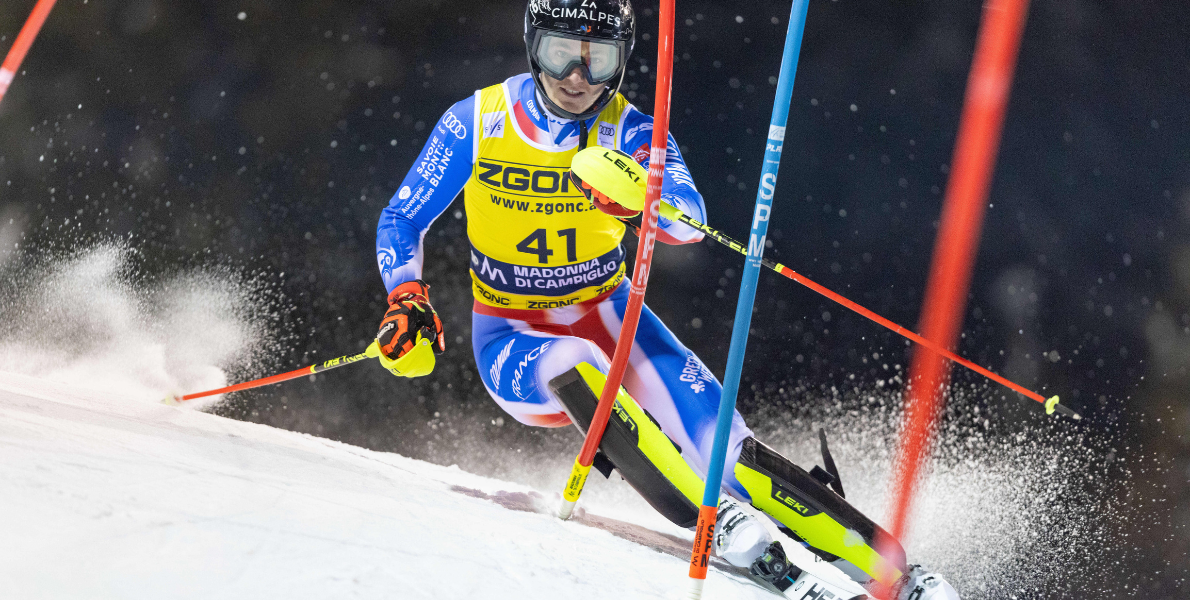
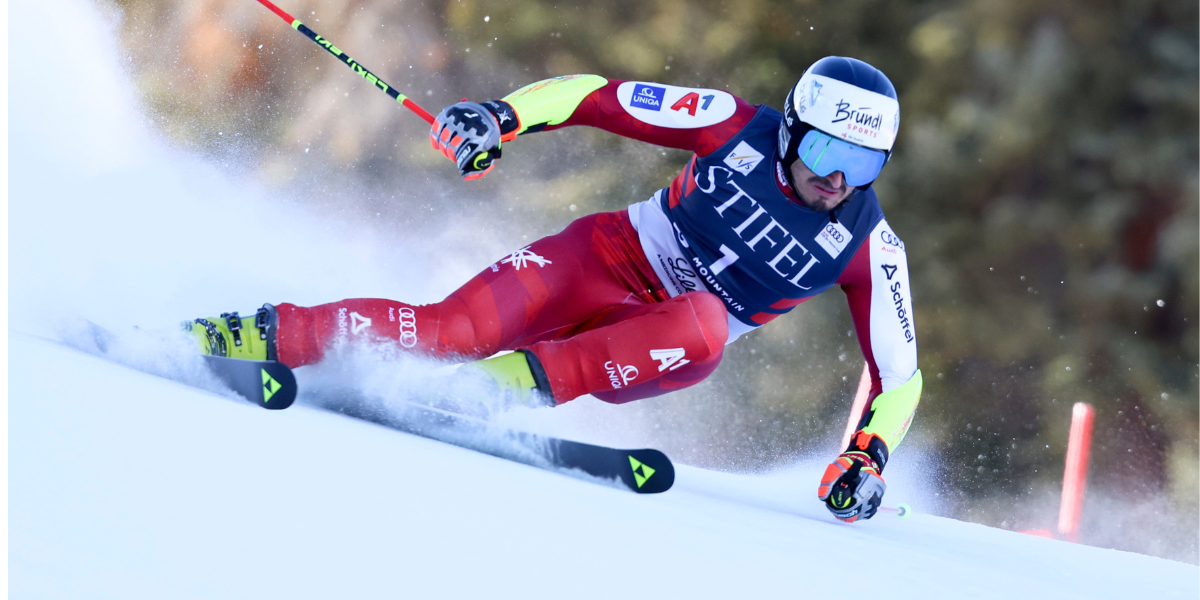
Stefan Brennsteiner Copper Cup GS / GEPA pictures
Brennsteiner leads tight Copper GS after first run
COPPER MOUNTAIN, Colorado — Austria’s Stefan Brennsteiner turned bib 1 into the first-run lead in Friday’s men’s Stifel Copper Cup giant slalom, setting the standard on a perfect early-race surface and holding it through a long, punishing morning at altitude.
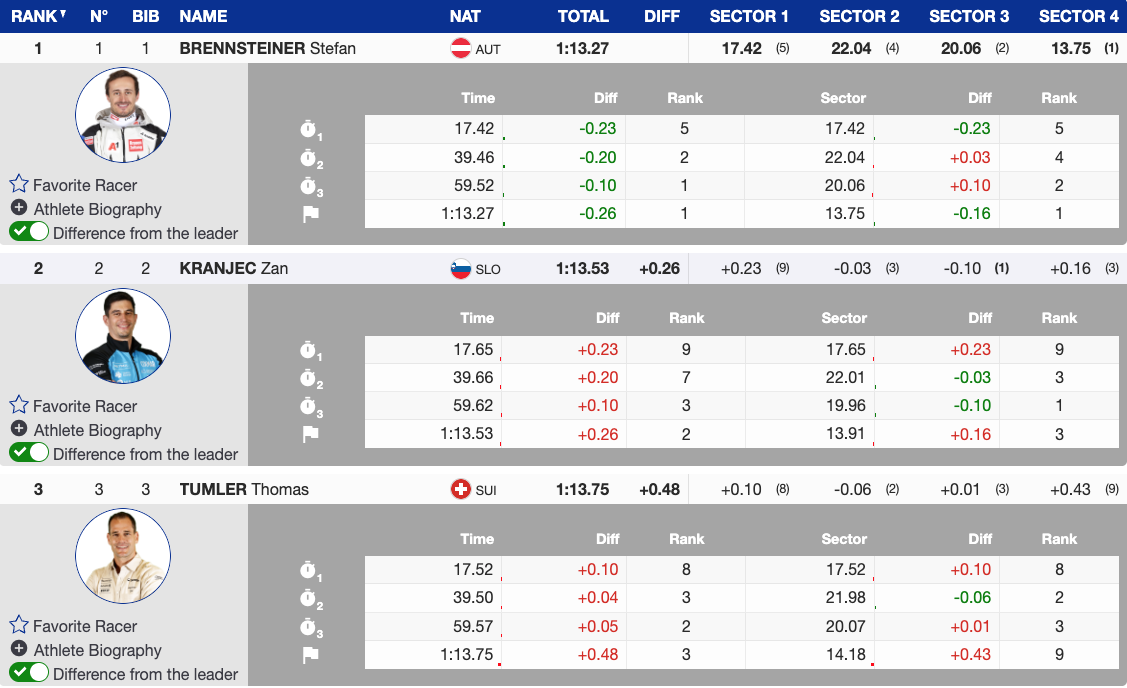
Brennsteiner’s 1:13.27 stood up all the way through the final starter. Slovenia’s Žan Kranjec is second at 0.26 back, with Switzerland’s Thomas Tumler third at 0.48. By the end of the run, only six racers sat within a second of Brennsteiner’s time, shaping a tight fight for the win this afternoon.
Elite group sets the tone — and Odermatt goes out
The elite seven starters defined the top of the board. Brennsteiner opened with a powerful, flowing run, backed by the day’s best final sector. Kranjec attacked from the top and stayed close all the way, losing just a touch of time in the final sector. Tumler completed the early top three with a strong middle section that kept him inside half a second.
“It was okay. I don’t think I’ve found the best setup for this snow yet, but I’m happy with the first run,” Tumler said. “You need more power and more pressure on this surface, and the elevation really hits after the third split, but I managed to take it to the finish.” — Thomas Tumler
Brazil’s Lucas Pinheiro Braathen sits fourth at 0.76, followed by Norway’s Henrik Kristoffersen at 0.80 and Austria’s Raphael Haaser at 0.83. Haaser, in his first season on Atomic, is the only racer outside the opening seven bibs to finish within a second of Brennsteiner.
The biggest shock came from Thursday’s super-G winner, Marco Odermatt. The Swiss star separated himself from the field through the first two sections, then lost grip on his left ski in the third split, dropped to his hip, and slid out. For the second straight season he failed to finish the second giant slalom of the winter, both times in Colorado.
“It was a classic inside-ski mistake,” Odermatt said. “On this snow you have to ski very smooth and clean on both skis, not just the outside one. You carry mistakes for a while because you don’t want to do them again, but it’s just a race — s*** happens — and next week there are three more chances.” — Marco Odermatt
Second-seed skiers close the gaps
The next wave of starters pushed hard to challenge the early order. Haaser’s 0.83 deficit made him the only racer beyond bib 7 to join the group within a second of Brennsteiner.
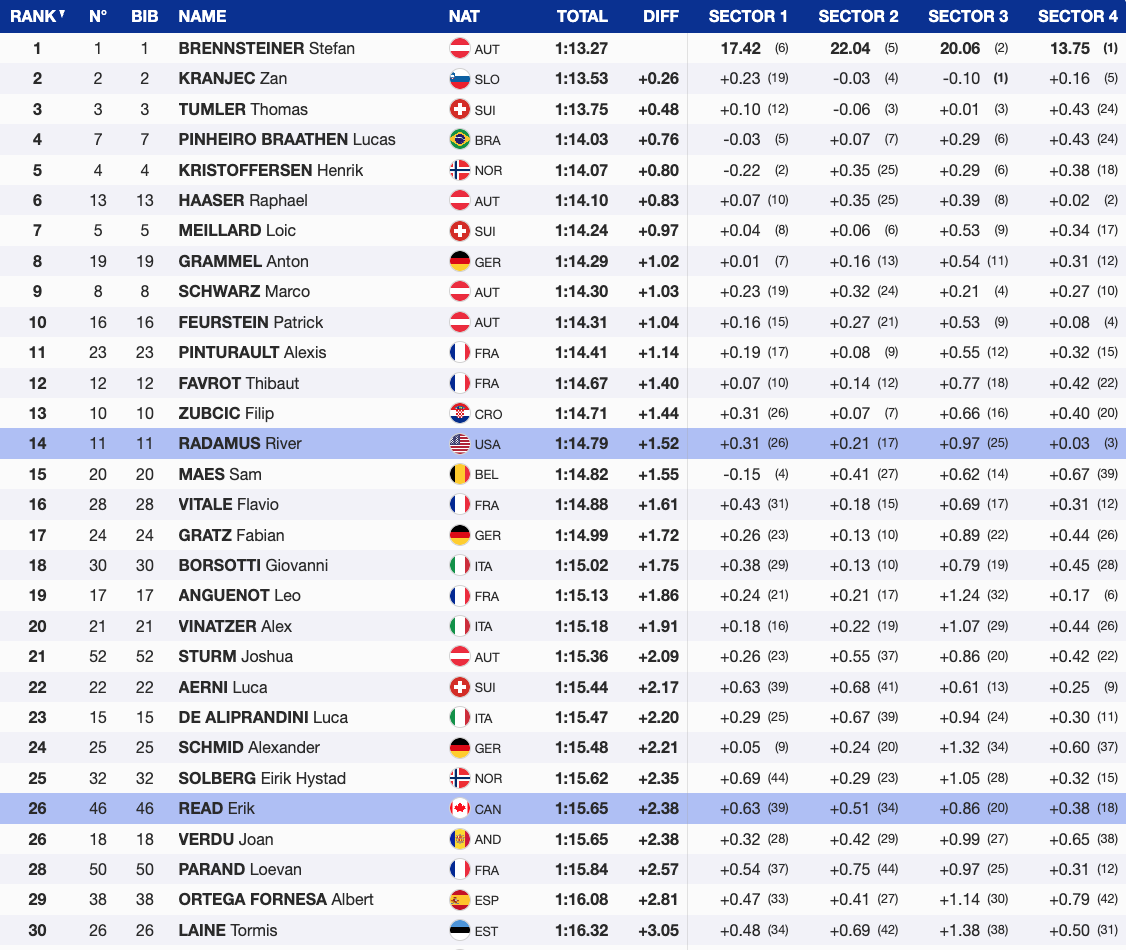
Germany’s Anton Grammel produced one of the runs of the morning from bib 19, sliding into eighth at 1.02 off the lead. Austria’s Marco Schwarz (ninth, +1.03) and Patrick Feurstein (10th, +1.04) kept the Austrian block strong, while Alexis Pinturault (11th, +1.14) and Thibaut Favrot (12th, +1.40) gave France solid depth just outside the fastest group.
After 30 racers, the pattern was set: only six men — Brennsteiner, Kranjec, Tumler, Lucas Pinheiro Braathen, Kristoffersen, and Haaser — were within one second of the lead.
Altitude punishes mistakes
The new Copper Mountain GS track is not especially long, but the elevation made every error expensive. Times ran longer than Thursday’s super-G, and many racers lost big chunks of time in the third and fourth sectors as fatigue built.
One of Norway’s young stars, Atle Lie McGrath, skied solidly through the first two sections before a major mistake in the third. He crossed 3.78 seconds back and will not return for the second run, adding to a difficult morning for a Norwegian squad that also lost Timon Haugan to a DNF. Kristoffersen, fifth at 0.80, is Norway’s lone frontrunner after the first run.
North Americans: Radamus in 14th, Read flips from deep
For North America, the focus is on two skiers: local favorite River Radamus and independent Canadian veteran Erik Read.
Radamus, the only North American starter inside the first 30 bibs, carried confidence from Thursday’s super-G but could not quite match the very best times. He finished 14th at 1.52 off Brennsteiner, losing most of his time in the middle splits but delivering one of the day’s stronger final sectors. The Stifel U.S. Ski Team racer will be disappointed with the gap yet remains well placed to attack in the afternoon.
Read, racing with bib 46, turned experience and clean skiing into another high-quality World Cup performance. The University of Denver graduate crossed 26th at 2.38 off the lead, an excellent result from deep in the field and one of the key late-bib stories of the morning.
“It felt smooth, and sometimes when it’s smooth you’re not sure it’s fast,” Read said. “On this snow the goal is to stay dynamic and clean all the way, and I did that. Now it’s about recovering and carrying that confidence into the second run.” — Erik Read
High-bib qualifiers: five men from bib 31 and higher
Five racers starting with bib 31 or higher qualified for the second run, led by an aggressive charge from Austria’s Joshua Sturm:
- 21st — Joshua Sturm (AUT), bib 52, +2.09
- 25th — Eirik Hystad Solberg (NOR), bib 32, +2.35
- 26th — Erik Read (CAN), bib 46, +2.38
- 28th — Loevan Parand (FRA), bib 50, +2.57
- 29th — Albert Ortega-Fornesa (ESP), bib 38, +2.81
Sturm was both the fastest and the highest-numbered bib among the above-bib 30 qualifiers, turning 52 into 21st place with a powerful, committed run.
Tight fight ahead
After one run, Austria holds four men in the top 10 and two in the top six, yet the race remains wide open. Six racers are within a second of Brennsteiner, several proven winners lurk just behind, and a hungry pack of high-bib qualifiers — including Sturm, Solberg, Read, Parand, and Ortega-Fornesa — will throw everything at the second run.
At altitude on Copper’s demanding GS track, with combined times deciding the result, nothing will be certain until the final racer crosses the line this afternoon.

Run Analysis of the Leaders and North American QualifiersClick images to enlarge

First Run top thirty results
About the Author: Peter Lange