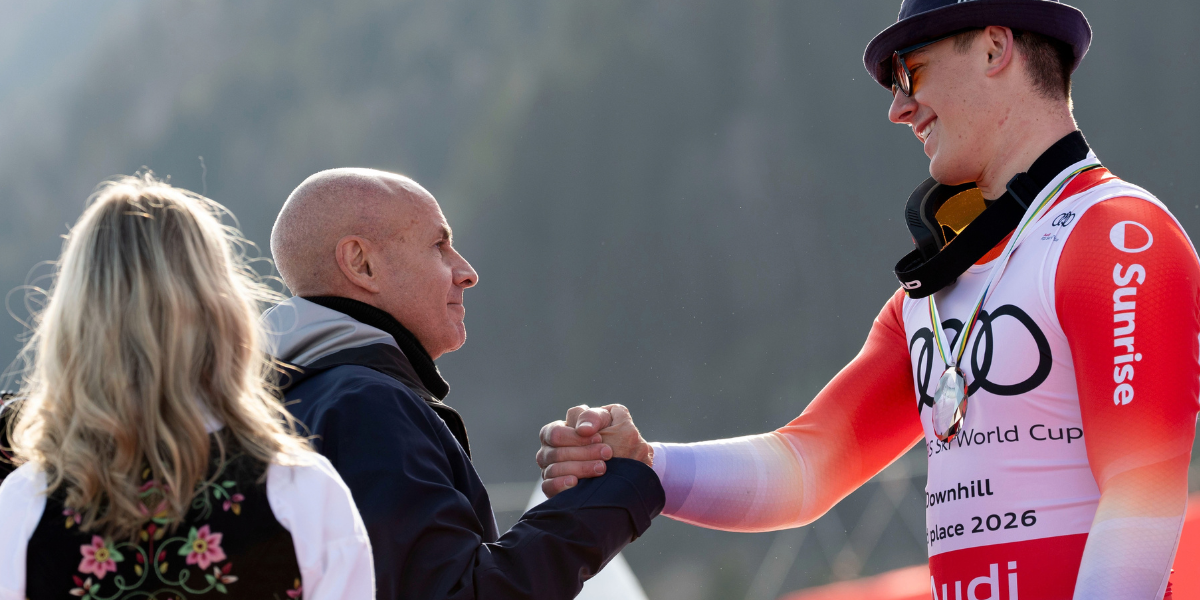

Alexander Ospelt, Liechtenstein, FIS President Candidate
Alexander Ospelt is not arguing that FIS needs a new direction.
The current FIS Council member supports many of the federation’s most significant reforms in recent years. He supports expanded athlete media and sponsor rights, increased prize money, financial distributions to national ski associations, continued investment in smaller federations and the broader effort to grow snow sports beyond their traditional strongholds.
Yet he is asking delegates to elect a new president.
His argument is not that FIS has chosen the wrong direction; it is that FIS has become too divided to reach its destination.
“I see that we have to unify,” Ospelt said during an interview with Ski Racing Media.
That belief — that unity, trust and governance have become some of the federation’s most pressing challenges — forms the foundation of his candidacy.
Beyond unity, Ospelt discussed financial responsibility, support for national ski associations, athlete development, transparency, continued growth across FIS disciplines and international expansion as key priorities for the federation.
Many of those initiatives are already part of FIS’s long-term direction. Ospelt’s focus is less on changing those priorities and more on how the federation pursues them and works together to achieve them.

Why does Ospelt believe he is the right candidate for this moment?
Born and raised in Liechtenstein, Ospelt comes from one of the smallest nations in FIS. Yet the country boasts one of skiing’s proudest traditions, producing Olympic and World Cup champions despite a population of fewer than 40,000 people.
Ospelt served as president of the Liechtenstein Ski Association from 2016 through 2023 before joining the FIS Council in 2024.
His professional background is equally diverse. A lawyer by training, he studied law at the University of St. Gallen in Switzerland, completed a degree in European law in Brussels, passed the Liechtenstein Bar Examination in 1997 and earned a doctorate in law in 1999. He later worked with Liechtenstein’s Permanent Representation to the United Nations in New York, practiced law and built a long career in business and governance.
Those experiences help shape his campaign message.
“Coming from a small federation, I have the opportunity to build bridges,” Ospelt said.
Why does Ospelt believe FIS needs more unity?
That may be the most revealing statement of the interview.
Throughout the conversation, Ospelt repeatedly returned to the same idea. He spoke about building bridges between large and small federations, communities and the council, athletes and fans, and traditional ski nations and emerging markets.
Nearly every challenge he identified eventually led back to the same conclusion: FIS functions best when its members work together toward common goals.
Of course, that objective is nothing new. International sports federations have pursued greater unity and cooperation for decades, and FIS is no exception. Successive leaders have sought to balance the interests of large and small federations, different disciplines, athletes, organizers and commercial partners while advancing the sport globally.
The difficulty has never been identifying the goal; it has been achieving it.
FIS today includes some of the world’s most powerful winter sports nations alongside developing federations, multiple disciplines with different priorities, commercial stakeholders, broadcasters, organizers and athletes whose interests do not always align. Building consensus in that environment is inherently challenging.
However, Ospelt is careful to distinguish unity from complete agreement.
He does not expect federations, disciplines or stakeholders to align on every issue. In an international federation as large and diverse as FIS, disagreement is inevitable. His argument is that decisions should be better understood and therefore more widely respected, even by those who may not fully agree with the outcome.
For Ospelt, trust is not built by eliminating disagreement but by creating transparent processes that members understand and believe in.
Is Ospelt running against recent FIS reforms?
The answer appears to be no.
One of the most interesting aspects of Ospelt’s candidacy is that he is not campaigning against many of the changes implemented during the past several years. As a member of the FIS Council, he participated in the democratic decision-making process that helped shape those policies.
During the interview, he voiced support for athletes’ rights to use competition footage on social media, expanded branding opportunities on helmets, increased prize money, athlete safety initiatives, and financial distributions to national ski associations.
He also supports the ongoing effort to centralize media and marketing rights, though he believes the process could have been structured differently.
Ospelt suggested that greater commercial alignment should emerge through a broader collective agreement. However, he acknowledged the challenge posed by existing commercial arrangements across federations and organizers.
His criticism focuses less on the direction of the reform and more on its implementation.
That distinction is important.
Ospelt does not present himself as an anti-establishment candidate. Instead, he is making the case that FIS can improve its governance while continuing many of the initiatives already underway.
His position in the race also carries an important distinction. As a current Council member, Ospelt brings firsthand knowledge of how FIS operates and shares responsibility for many recent decisions. He also does not face the same level of scrutiny that naturally accompanies an incumbent president, who becomes the public face of both the organization’s successes and, even more so, its controversies.
That places him in a unique position. He can point to progress he helped support while arguing that governance, transparency and unity need improvement.
His criticism focuses less on policy and more on process.
“I think there is a lot of politics going on in the FIS Council,” Ospelt said. “I want to shape it more so that sports is the topic we should discuss.”
Can better governance strengthen FIS?
Governance may be the issue Ospelt discussed most consistently.
He believes FIS already possesses tremendous expertise through its committees, technical experts and member federations. However, he suggested that committee recommendations do not always reach the Council effectively enough.
That may sound like an administrative issue, but it carries significant consequences.
International sports organizations rely on committees to evaluate athlete safety, competition formats, calendars, equipment regulations and long-term development strategies. If recommendations become diluted before reaching decision-makers, organizations risk losing valuable expertise.
Ospelt prefers a more transparent process in which committee summaries are shared directly with Council members.
His proposal is not revolutionary, yet it reflects a broader philosophy that runs throughout his campaign. Ospelt believes that greater transparency builds trust and gives members greater confidence in FIS’s decisions.
How does Ospelt view financial responsibility and transparency?
Governance and financial responsibility are closely connected in Ospelt’s vision for FIS.
He believes the federation must maintain reliable financial oversight while pursuing sustainable long-term planning and modern commercial models that create new value for the sport.
That approach does not mean abandoning investment. Ospelt supports continued funding for athletes, national ski associations and development initiatives. He believes growth should be built on sound financial foundations that can be sustained over time.
Transparency, he argues, should also extend to the presidency itself.
Asked whether he would follow the current practice of serving without a salary and covering his own expenses, Ospelt said he would first analyze the current situation and historical practice. However, he added that the costs associated with the president’s office should be reduced and made transparent.
This view reflects a broader theme running throughout his campaign. Ospelt repeatedly emphasized transparency and accountability. He wants stakeholders to understand how FIS makes decisions and allocates resources.
Can FIS continue expanding globally?
Like many, Ospelt believes one of FIS’s greatest opportunities lies in international growth.
“We have to show that we are world sports,” he said.
However, his comments should not be interpreted as criticism of current efforts. Expanding participation and strengthening smaller federations already rank among FIS’ strategic priorities. The organization has invested significant resources into athlete development, federation support and broader international engagement.
Ospelt supports those efforts.
His argument is that FIS should continue building on that foundation while helping regions identify the disciplines that best fit local interest and culture.
He pointed to Lucas Pinheiro Braathen’s decision to compete for Brazil as an example of how athletes can help expand the sport’s reach beyond its traditional Alpine strongholds.
“Everybody was speaking about Lucas Braathen,” Ospelt said. “I think it was very good.”
What is the NSA Connector Platform?
One of the more concrete proposals discussed during the interview is an NSA Connector Platform.
The concept would help national ski associations connect with each other to share expertise, contacts, training opportunities and cooperation possibilities across regions and disciplines.
For larger federations, that may sound straightforward. For smaller federations, however, access to knowledge and relationships can be just as valuable as financial support.
Coming from a small federation himself, Ospelt believes FIS can play a greater role in helping member nations learn from each other to avoid operating in isolation.
The proposal reflects Ospelt’s view that FIS can play a larger role in helping member nations share resources, experience and expertise.
How would Ospelt invest in regional growth?
The broader idea is straightforward. Ospelt believes FIS should embrace the diversity of its disciplines and use them strategically. Rather than expecting every market to embrace the same events, he suggests focusing on regional strengths and building around existing interests.
China, for example, may offer different opportunities than Central Europe. Nordic disciplines may resonate differently than alpine disciplines. Snowboard and freestyle events may attract audiences that traditional racing does not.
The challenge is not creating interest everywhere in the same way; it’s identifying where interest already exists and helping it grow.
Ospelt supports targeted regional investment through events, competition pathways, local partnerships and long-term planning that can strengthen national ski associations, athletes and the broader snow sports ecosystem.
His approach focuses on building sustainable local systems rather than applying a single model across every region.
Why does Ospelt want support for all FIS disciplines?
Another theme that emerged during the interview was the importance of maintaining a balanced approach across all FIS sports and disciplines.
Alpine skiing remains the federation’s most visible product, but Ospelt believes the long-term health of FIS depends on supporting the full spectrum of snow sports.
That includes Nordic disciplines, freestyle skiing, freeskiing, ski cross, snowboard cross, snowboarding and other snow sport disciplines that often operate with different competitive and commercial realities than alpine skiing.
His argument is not that FIS should treat every discipline identically. Instead, he wants FIS to give each discipline an equal opportunity to develop and thrive according to its own needs and opportunities.
The same principle applies to athletes. Ospelt believes support systems should be designed with the broader athlete community in mind, not just the most commercially successful disciplines.
What role do athletes play in the future of the sport?
Ospelt also believes athletes must become more visible.
As sports fans increasingly consume content through social media and streaming platforms, he argues that snow sports need to bring athletes closer to audiences.
“We have to work on programs that bring the athletes closer to the audience,” he said.
That idea doesn’t start from scratch. FIS has already made a significant investment in different media platforms and athlete-centered content, and the value of that effort has become increasingly clear. Projects such as the Stifel U.S. Ski Team’s ““Qualified” series and “On the Edge” have also shown how behind-the-scenes storytelling can help fans understand the athletes, pressure, travel, relationships and personalities that define the sport beyond race day.
Ospelt referenced Formula One’s success with behind-the-scenes storytelling and athlete-focused content.
That perspective aligns with a broader trend throughout sports. Fans often connect with personalities before they become dedicated followers of a competition.
Can prize money increase?
Ospelt sees athlete development and athlete compensation as connected issues.
Like his opponent, he supports increasing prize money by 20%.
But he also emphasized that FIS, athletes and organizers need to discuss any increase, determine what contribution organizers can realistically make and develop a sustainable implementation plan.
This position reflects a pragmatic approach. Rather than making promises disconnected from financial realities, Ospelt argues that meaningful improvements require collaboration between athletes, organizers and governing bodies.
If successfully implemented, higher prize money could provide meaningful support for athletes while strengthening the appeal of elite competition.
How should FIS address climate and calendar concerns?
Climate change remains one of the most significant long-term challenges facing winter sports, and Ospelt believes FIS must respond accordingly.
His primary concern involves travel and calendar planning.
Rather than repeatedly moving between continents during the same season, he prefers a more logical regional structure that reduces unnecessary travel and creates greater efficiency.
Such a system could lower costs, reduce environmental impact and provide more predictable planning for athletes, teams and organizers.
But this discussion also highlights the complexity of the issue.
While Ospelt focused on competition calendars, the interview did not explore how preseason training and Southern Hemisphere travel fit into the broader environmental conversation. Modern ski racing still relies heavily on global travel before the season begins.
Can centralized media and marketing rights be improved?
Perhaps no issue better illustrates both the appeal and difficulty of Ospelt’s candidacy.
He supports the recent centralization of media and marketing rights.
“I am in favor of that,” he said.
However, he wants stakeholders to negotiate the process more collectively.
His legal background may help explain that perspective. Ospelt argues that a truly centralized structure should emerge from a broader consensus rather than a series of separate bilateral arrangements.
A more unified commercial framework could create a stronger global product, simplify negotiations and potentially increase revenue opportunities.
He acknowledged that achieving that outcome would be difficult because national federations, organizers, broadcasters, sponsors and athletes all possess competing interests.
Bringing those interests together would require substantial compromise from all sides.
What is Ospelt really asking voters to support?
Most presidential campaigns focus on specific policy proposals.
Ospelt’s campaign is different.
During the interview, he discussed governance, international growth, athlete rights, climate concerns, commercial development, media strategy, financial responsibility, prize money, support for all disciplines and transparency, yet nearly every topic eventually returned to the same theme: unity.
However, Ospelt’s definition of unity is more nuanced than simple agreement.
He believes disagreements will always exist inside an international federation as large and diverse as FIS. His goal is not to eliminate those disagreements; it is to create processes that members trust and decisions that members understand.
Ospelt believes the sport’s current initiatives deserve continued support. He sees value in stronger athlete rights, broader international development, increased investment and improved commercial opportunities.
His concern is not that FIS lacks direction; it’s that the organization has become too divided to fully realize its ambitions.
That reality helps explain both the appeal and challenge of Ospelt’s candidacy. Throughout the interview, Ospelt repeatedly returned to themes of governance, transparency, communication and trust as areas where he believes FIS can improve.
What is clear is that Ospelt is not asking voters to abandon the direction FIS has taken over the past few years.
He is asking them to believe the federation can achieve more if it becomes less divided.
Whether delegates agree with that vision will become clear when FIS members cast their votes on June 11th.
About the Author: Peter Lange