Giovanni Franzoni / Kitzbühel 2026 / GEPA pictures
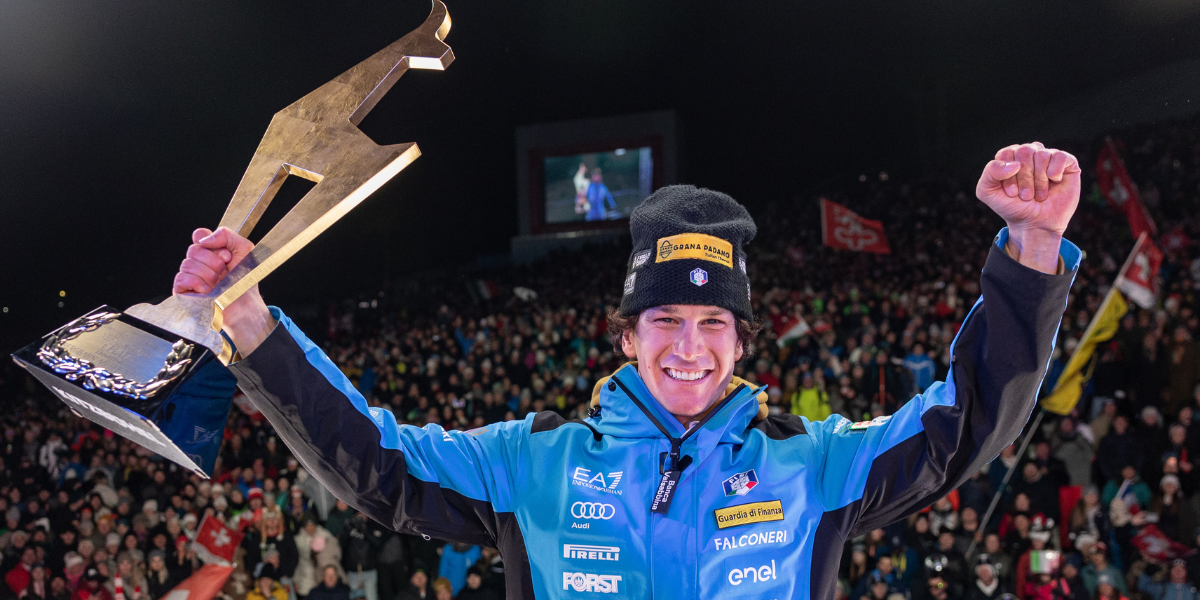
He won in Wengen. He won in Kitzbühel. And he won our hearts. Giovanni Franzoni’s breakthrough season was impressive and emotional. He stepped into the World Cup and Olympic speed arenas with solid skiing, capturing legendary victories and an Olympic silver medal. Along the way, he emerged as one of the most compelling athletes of the 2025/26 ski season, sharing his emotions and inspiring others. The tragic loss of teammate and friend Matteo Franzoso changed Franzoni’s outlook on life.
This spring, Franzoni spoke with Ski Racing Media about the path that brought him to where he is today.
How Franzoni built the foundation for success
Franzoni recorded a lot of “firsts” during the 2025/26 ski season: his first World Cup podium, first World Cup victory, first Olympic Games appearance and first Olympic medal.
What helped Franzoni reach the sport’s highest level?
“I was pretty fanatical [about] skiing when I was a child. I was in my room all the time watching videos, sports videos of the best athletes of the world. It was just my passion.
“Setting goals every year, higher and higher. But I couldn’t expect this switch this year.
“Maybe all the hard work that I did during the last seven to eight years worked out and this year is the revelation. It wasn’t just this year, I made a long journey and I’m pretty proud of it,” the Italian told Ski Racing Media during the 2026 World Cup Finals.

The 2025/26 season highlight
What does Franzoni see as his greatest accomplishment?
“Maybe the win in Kitzbühel—yeah, absolutely! The Olympics were incredible, but what I felt in Kitzbühel was something special and magical and I will not, I think, feel these emotions again in another race,” he said.
The legendary setting and electric atmosphere of the Kitzbühel Hahnenkamm World Cup weekend make it one of the most distinctive events in ski racing. One year earlier, Franzoni and Franzoso shared a room there during the Hahnenkamm weekend. It was Franzoni’s first experience of Kitzbühel and Franzoso’s second. Returning a year later, Franzoni carried those memories with him into one of the most emotional victories of his career.
This season, Franzoni dedicated all his races to the friend he misses so much.
“I won this race, and it’s the max that I can do for him. I thought he’s watching right now from the heaven, so it’s unbelievable,” Franzoni said, smiling through tears during an FIS interview after winning the Hahnenkamm downhill.
“Today, I take the win, and I am so happy, also for my parents. They worked a lot to give me this possibility to race here,” he said gratefully.
The emotional story of honoring a friend
In September 2025, the Italian team and the ski racing world were shocked and deeply saddened when yet another young athlete’s life was lost in training. Italian Matteo Franzoso passed away at age 25 after a training accident in Chile.
Less than a year earlier, 19-year-old Matilde Lorenzi had also suffered a fatal training crash.
In December 2025, Franzoni climbed the World Cup podium for the first time, finishing third in the Val Gardena-Gröden super-G. Afterwards, Franzoni shared his emotions during an FIS interview while talking about Franzoso:
“I will ski for him all my life. So, we will do this together.
“I think the most important thing is the result, as a team, because we struggled a lot this summer because of our loss of our teammate, Matteo.”
In January 2026, Franzoni captured his first World Cup victory in the Wengen super-G. The following day, he finished third in the downhill there before winning in Kitzbühel a week later.
The inspirational power of an Olympian
Heading to the Milan-Cortina Olympics in February, Franzoni had become a major contender and a favorite among home-country fans.
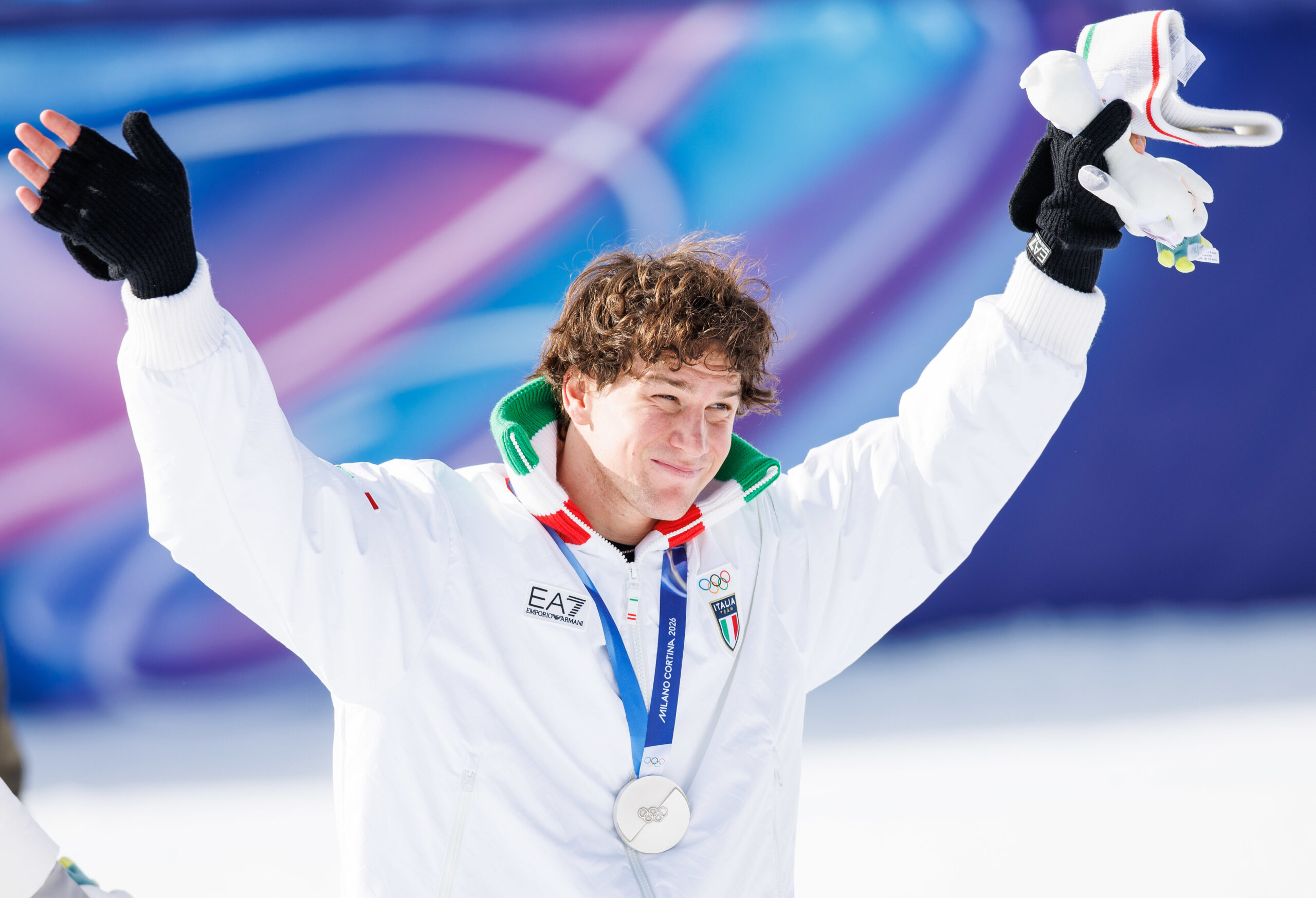
In front of a home crowd, he captured the Olympic downhill silver medal.
Franzoni finished just 0.20 seconds behind Franjo von Allmen, who won his first of three Olympic gold medals in 2026. Italy’s Dominik Paris, an idol and mentor to Franzoni, finished third.
Afterwards, Franzoni turned to the younger generation in a Sky Italia interview, according to Olympics.com:
“I hope to be an inspiration to kids who aren’t confident in what they’re doing.
“You don’t need an extreme ego to be an athlete and win medals or races; the important thing is to enjoy it.”
Click on the image to enlarge
Franzoni’s new vision on life
Ski Racing Media asked Franzoni how the loss of his friend has shaped him, both in his skiing and as a person.
“I think that’s a really good question, because after that, I changed something in my mind, not just something in my skiing, but my vision about life.
“The year before, I was always thinking about the results and the performance. But this year, I could find a new perspective on life; that I really have to enjoy every day, whether it’s bad or good, and really enjoy the day of skiing, the day that I rest, the day that I train. Because not everyone can do it, so it’s good to not waste time and do all this 100%, every day.”
How it started – by the Lake
Franzoni’s athletic journey started around 25 years ago. Giovanni and his twin brother Alessandro were born March 30, 2001, and grew up in Manerba del Garda on the Brescia shore of Lake Garda.
Their parents introduced the twin boys to a variety of sports to help channel some of their energy.
“I think we tried all the sports and when she [mother] asked us what we preferred, we said alpine skiing.”
The family had to travel to the mountains to ski.
“We started skiing near Madonna di Campiglio. Then we moved there for the winter season when I was eight years old, and I lived there for the winters for like 10 years.”
How Latin builds character
Franzoni believes many of the qualities that helped him succeed on snow were developed long before he reached the World Cup.
Education was always a central part of the puzzle for the Franzoni family. In high school, the twins completed a demanding science curriculum that included Latin.
According to a Feb. 9, 2026, interview with La Gazzetta dello Sport, Franzoni’s mother linked the study of Latin to a “sense of sacrifice” and viewed the science studies as a way to help her sons get accustomed to hard work. Good grades were a prerequisite for skiing.
“The most important thing was school and then skiing. So, if you are good at school, you could go skiing. This was our ‘law’ in the family. It was a pretty good rule, so I’m happy with that,” Franzoni told Ski Racing Media.
At first, the twins attended high school in Brescia, south of the mountains. After school, their mother drove them two hours to Madonna di Campiglio for ski training.
The daily routine was demanding. Meals and homework during the long drives became part of everyday life.
“It was pretty hard,” Franzoni said.
“But I think it was pretty good for our character and personality,” he added, explaining that the demands made them stronger.
“Also, my brother had the possibility to go to the university [after high school], so that was a pretty good idea from our parents.”
Giovanni’s high school legacy
After one year of balancing high school in Brescia, ski training in Madonna di Campiglio, and the long commute between the two, Giovanni and Alessandro moved to Ski College Veneto in Falcade in the Dolomites.
There, they could better balance the demands of ski racing with a full science education.
Franzoni left a positive legacy at Ski College Veneto-Falcade.
Eddy Gaspari, an academic tutor during Franzoni’s school years, described him as a calm and well-organized student.
“Always on the ball, both in school and in sports. In terms of manners and respect, I’d say A+,” Gaspari told Sciare Magazine in March 2020.
Michele Costa, the current principal at the ski college, also praised Franzoni.
“He was a model student in school. This is a significant detail for those who choose this path, which, from the outside, may seem fun, even easy, but in reality, presents quite a few challenges.
“We are truly proud of him. The kids, at school and on the slopes in training, feel close to him, because until very recently he was one of them, and today he is competing in the Olympics: a great and beautiful example. We hope he can be a role model for our young athletes and students, both for his passion and for the commitment he puts into everything he does— always with a smile and a positive attitude,” Costa told ilNordEst on Feb. 7, 2026.
Finding ways to combine ski racing and education?
Combined education and ski racing programs are not as common in Italy as they are in many other countries, according to Franzoni.
He believes it is important to create opportunities for young people to pursue both.
“It’s important to grow up with the healthy values and all the responsibilities,” he told Ski Racing Media.
The discussion continues in Italy about how best to create pathways that allow young athletes to combine education with elite sport.
One example is the annual “school-sport” conference promoted by the La Rosa Bianca-Weisse Rose institute in Predazzo. Talented alpine skiers Anna Trocker and Giada D’Antonio were among the athletes invited to participate in the May 21 conference alongside educational, sports and institutional representatives, Sciare Magazine reported.
Franzoni as an educational role model
The Franzoni family successfully combined a strong educational foundation with high-level sports.
Orizzonte Scuola—an Italian digital newspaper dedicated to the school system, teaching and education—highlighted their path.
“Giovanni Franzoni’s journey exemplifies a potential integration between school and high-level sport, in which the student-athlete maintains a strong scholastic identity.”
After describing the family’s choices, Orizzonte Scuola concluded in a Feb. 10, 2026, article:
“The story opens a space for reflection for educational institutions.”
How does it make him feel that his and his family’s story is used as an example of how the Italian education system can include athletes?
“Pretty good! I think it’s inspiring. We didn’t do magical stuff, but with some commitment we could do school and skiing together,” Franzoni replied.
His answer echoed the same modesty described by coaches, teachers and mentors throughout his career.
“It is not so easy. But leaving this story behind to the next generation, I think it’s important to give them confidence to do both.”

Giovanni’s close ties with twin brother
Franzoni did not travel this path alone.
“It was a pretty good journey, always with my twin brother. That’s very special,” Franzoni said when describing the close connection with Alessandro and the years they spent growing up as skiers, including attending ski college in Falcade together.
“Now he’s my biggest fan. It’s incredible that I could reach these results, and this is also for him.”
Alessandro now works with their father at the family winery, which has been owned and operated by the family for generations. During the winter, he also works as a ski instructor.
“He knows skiing really well, and sometimes I send him videos to analyze and hear tips from my brother,” Franzoni said, smiling.
Sharing podiums with Franjo
Franzoni became a member of the Italian national team in 2020. Progress came steadily rather than suddenly.
In 2022, he won both the European Cup overall title and the super-G discipline title.
He competed in three FIS Junior World Ski Championships from 2020-22, winning three gold medals, one silver and one bronze, across four disciplines: downhill, super-G, giant slalom and alpine combined.
At the 2022 Junior World Championships, he shared the podium with the four-month-younger Franjo von Allmen in three disciplines, including the downhill, where Franzoni won gold by 0.24 seconds.
The margin almost matched the one separating the two when they stood on the Olympic downhill podium together this winter with only the positions reversed.
“Chapeau to Franjo, what an amazing week, such a great guy, such an amazing skier. I need to take him as an inspiration, to learn about the gliding part and to be a more competitive athlete,” Franzoni told Norwegian broadcaster NRK after finishing sixth in the Olympic super-G, where von Allmen secured his third Olympic gold medal in five days.
Reflecting on his own Olympic super-G performance, Franzoni added:
“This is ski racing; sometimes you win, sometimes you learn.”
Franzoni summarizes his 2025/26 season
How does Franzoni describe his breakthrough season?
“Amazing, incredible. At the start of the season, I couldn’t expect these results, especially in downhill. It was not my top discipline,” he told Ski Racing Media at the World Cup Finals.
Franzoni made his World Cup debut in the Alta Badia giant slalom in December 2020, and his expectations initially were greater in super-G than downhill.
“This year, I could switch something in my mind and, with some more training in the speed disciplines, I could bring these incredible results. So, I’m really happy. I’m proud of myself.”
Franzoni made tremendous strides in the 2025/26 World Cup standings, finishing fourth in the super-G standings, fifth in downhill and 10th overall after placing 13th, 32nd and 49th, respectively, the previous season.
Giant slalom for the 2026/27 season
Franzoni qualified to start in all disciplines at the World Cup Finals after scoring more than 500 points overall. In addition to the speed events, he raced the final giant slalom and finished 21st.
What are his thoughts on giant slalom moving forward?
“It’s a discipline I want to keep up, but it’s a long journey. I started with giant slalom in the World Cup, and it was my first discipline. Right now, I moved to the speed disciplines, and I feel more comfortable there.
“During the year, it’s so difficult to train GS, training in general, because of all the [speed] training runs and races. But I really want to do giant slalom also next year.
“Maybe I will try the first three. In Sölden, maybe like this year, it will be the one I can prepare [for] more and be ready. Then, Copper Mountain and Beaver Creek, [because] I am there for the speed races. And then we will see, during the season, how it has gone in the first giant slaloms.
“It’s not a journey from one year to another. It’s always hard being the last in the races, because I’m not [skiing] full giant slalom right now, but I really want to build up this discipline year by year and become stronger. I think the base from the giant slalom is important also for the speed disciplines.”
Chances against Odermatt in the overall World Cup?
Does Franzoni think about challenging for the overall World Cup in the long term?
“Yes, it would be great. Maybe when Marco will be tired of winning that, it would be a chance,” Franzoni said with a laugh.
“Because he wins in three disciplines, it’s so hard right now. But, in the long term, never say never. We will see.”
Marco Odermatt remains the benchmark in men’s alpine skiing. Yet Franzoni’s breakthrough season showed how quickly careers can change.
Only a year ago, few would have predicted World Cup victories in Wengen and Kitzbühel, an Olympic silver medal and a place among the sport’s rising stars.
Now, Franzoni enters the next phase of his career with a new perspective on life, Olympic silver and the confidence that comes from proving he belongs among the world’s best.
About the Author: Bente Bjørnsen Sherlock