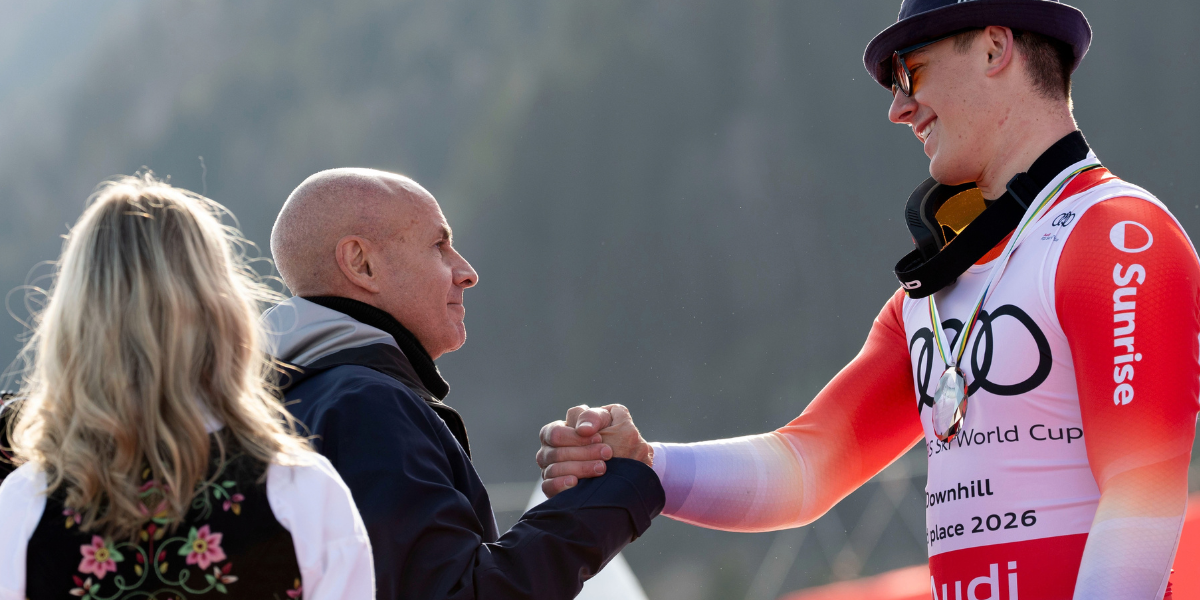
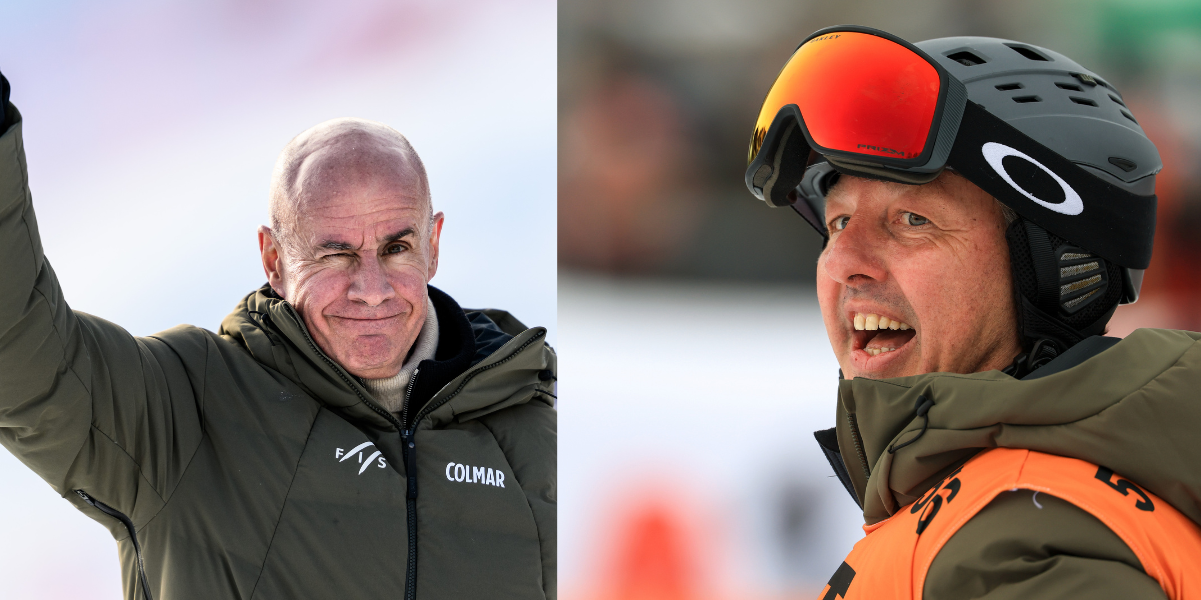
Johan Eliasch and Alexander Ospelt / GEPA pictures
The International Ski and Snowboard Federation (FIS) will elect its next president on June 11, deciding who will lead the organization through the next four years of opportunity, pressure and continued change.
Supporters on both sides have framed the vote as a choice between competing visions for the future. Yet after interviewing both remaining candidates and reviewing their policy positions, a more precise question emerges:
What are delegates actually choosing?
The answer may be more nuanced than many observers expect.
Johan Eliasch, the incumbent president, is seeking another term after leading FIS through media-rights centralization, increased distributions to national ski associations, expanded athlete marketing rights, increased prize money, safety initiatives, organizational growth and significant commercial expansion.
That distinction matters because both men hold leadership roles within FIS while the federation adopted and implemented many of the reforms discussed throughout this campaign. Eliasch has served as president since 2021. Ospelt has served on the FIS Council for the past two years.
Neither candidate attacked the other during interviews with Ski Racing Media. Both acknowledged progress within the federation and emphasized continued evolution rather than dramatic change.
Where Do the Candidates Agree?
Looking strictly at policy positions discussed during interviews with Ski Racing Media, the level of agreement is notable.
| Issue | Johan Eliasch | Alexander Ospelt |
|---|---|---|
| Athlete marketing rights | Supports expanded athlete marketing opportunities | Supports expanded athlete marketing opportunities |
| Prize money | Supports continued increases in prize money | Supports continued increases in prize money while emphasizing organizer involvement |
| Support for smaller NSAs | Supports increased distributions and development programs | Supports increased distributions and development programs |
| Athlete safety | Supports continued investment in safety initiatives and athlete health programs | Supports continued investment in safety initiatives and athlete health programs |
| Global growth | Supports expanding the global reach of snow sports | Supports expanding the global reach of snow sports |
| International expansion | Supports growth in new markets, including Asia and emerging snow-sport nations | Supports growth in emerging markets and stronger regional development pathways |
| Commercial growth | Supports expanding revenues, sponsorships and media value | Supports commercial growth and new revenue opportunities |
| Development of emerging ski nations | Supports development programs and federation support | Supports development programs and stronger cooperation among federations |
| Athlete representation within FIS | Supports athlete involvement in committees and governance | Supports athlete involvement in committees and governance |
| Media-rights centralization | Supports centralization and views it as an important achievement that continues to evolve | Supports centralization but believes governance, communication and implementation can be improved |
Neither candidate campaigned on dismantling the major reforms introduced during the past five years.
Continued investment in smaller national ski associations remains a priority for both men. Athlete marketing rights and additional commercial opportunities also receive support from each candidate. Increased prize money, stronger safety initiatives and broader international participation represent additional areas of agreement. Both candidates want to expand snow sports beyond their traditional Central European base and grow participation, audiences and opportunities in emerging markets around the world.
Continuity Rather Than Reversal
Neither candidate is arguing that FIS should reverse course on the major structural changes implemented during Eliasch’s presidency. While Eliasch introduced many of those reforms, the FIS Council approved them through the federation’s governance process. Ospelt has supported and voted for many of the resulting initiatives, including athlete rights, development programs, increased support for national ski associations, safety investments and commercial growth.
Before joining the FIS Council, Ospelt led the Liechtenstein Ski Association, one of the smaller national ski associations that received increased distributions and development support during Eliasch’s presidency. He later joined the FIS Council, where he voted in favor of many of those reforms as FIS rolled them out across the federation.
For delegates looking for two radically different policy agendas, the overlap is difficult to ignore.
Where Do the Differences Emerge?
The clearest distinctions appear not in the destination, but in how each candidate believes FIS should get there.
Governance
Eliasch points to the federation’s current direction as evidence that its strategy is working. Increased revenues, expanded reach, organizational growth, greater global visibility and larger investments in athletes and national ski associations form the core of his case for another term.
Ospelt places greater emphasis on transparency, communication and engagement with FIS members. He says committees, organizers, national ski associations and stakeholders should have a clearer path to influencing council discussions and decision-making.
Ospelt also supports FIS Council member Fiona Stevens’ proposed NSA Connector Platform, an initiative designed to help national ski associations share expertise, coaching resources, training opportunities, contacts and development strategies across regions and disciplines.
For Ospelt, governance reform is not an end in itself. He presents it as a way to improve trust, strengthen cooperation and help FIS make better decisions as the federation continues to evolve.
Media and Marketing-Rights Centralization
Both candidates support centralized rights.
For Eliasch, media and marketing-rights centralization is one of the most important achievements of his presidency and a foundation for future growth. He points to increased revenues and broader opportunities created by the strategy while also acknowledging that the process remains a work in progress as FIS continues to evolve.
Ospelt supports the concept but believes FIS can improve how it negotiates, implements and governs major commercial agreements. His position is not to abandon centralization, but to improve governance, communication and stakeholder involvement around major commercial decisions.
Financial Oversight and Transparency
Financial oversight may be one of the clearest examples of how the candidates differ in emphasis rather than objective.
Neither candidate is arguing against using asset distributions to invest in the sport. Both support continued growth, stronger national ski associations, athlete development programs and increased opportunities for competitors.
Eliasch presents the federation’s current strategy as one that is producing measurable results. During his presidency, FIS has increased revenues, expanded commercial partnerships, made significant progress in centralizing media and marketing rights, increased distributions to national ski associations, supported higher World Cup prize money, expanded Olympic participation and grown its membership base.
Those developments, in Eliasch’s view, demonstrate that FIS is moving in the right direction. Rather than changing course, he believes the federation should continue building on that momentum while further evolving its commercial, digital and international growth initiatives.
As a member of the FIS Council, Ospelt supported many of those initiatives and does not dispute the importance of growth. His campaign, however, places greater emphasis on transparency and accountability.
Viewed broadly, both candidates support continued investment in the sport. Their disagreement centers less on whether FIS should grow and more on how federation leaders should manage, oversee and communicate that growth.
Presidential Compensation and Governance
In a follow-up clarification provided to Ski Racing Media, Ospelt wrote: “Regarding my compensation, I will first analyze the situation as it is and was practiced in the past, but for sure the costs for the president’s office have to be reduced, and I will make transparent the cost of the presidency.”
The comments reflect a broader discussion about governance inside FIS.
Former FIS President Gian-Franco Kasper, who led the federation from 1998 through 2021, reportedly received approximately CHF 1.4 million in compensation and had expenses covered by the federation.
Eliasch adopted a different model after taking office, receiving no salary as president and paying his own expenses.
Ospelt has not proposed a specific compensation package for himself. Instead, he says he would first review existing practices while making the costs associated with the presidency more transparent.
The distinction is less about compensation itself and more about governance. Eliasch points to financial growth, larger distributions, higher prize money and expanded investment throughout the sport as evidence that the federation’s current approach is delivering results. Ospelt believes FIS should match continued growth with clearer reporting, greater transparency and stronger accountability for the decisions leaders make and how they allocate resources.
Leadership Philosophy
Eliasch’s campaign is built around continuing reforms already underway.
Ospelt’s campaign is built around improving member relations and FIS’s internal operations while maintaining many of the initiatives already in place.
That distinction may explain why both candidates often sound similar when discussing objectives but different when discussing process.
What Are Delegates Actually Choosing?
That may be the central question facing voters.
Ospelt has criticized aspects of FIS governance and decision-making. At the same time, he supports many of the athlete, federation, safety and development initiatives introduced during Eliasch’s tenure.
Eliasch, meanwhile, is not arguing that the federation’s work is complete. His campaign is built on the belief that the reforms FIS has adopted over the past five years are producing measurable results and should continue to evolve.
As a result, delegates do not appear to be choosing between two fundamentally different visions for skiing and snowboarding. Both candidates support growing the sport, expanding opportunities for athletes, strengthening national ski associations, increasing prize money, improving safety and reaching new audiences around the world.
The more significant distinction lies in leadership philosophy.
Eliasch believes the federation’s current direction is working and should continue building on its momentum. Ospelt believes FIS can achieve many of the same objectives while placing greater emphasis on transparency, communication, stakeholder engagement and governance.
Commercial growth, athlete development, climate challenges, calendar planning, federation support and global expansion will remain central issues regardless of who wins Thursday’s vote.
Political debates inside FIS are unlikely to disappear with the election result. Neither will disagreements about priorities, governance or strategy. Competitive people rarely agree on every decision, particularly in international sport.
Why the Election Still Matters
The significance of Thursday’s vote should not be understated. The next president will influence governance, commercial strategy, federation relations, athlete opportunities and the pace of future reforms.
At the same time, the election does not appear to be a choice between preserving FIS and fundamentally remaking it. Both candidates support continued growth, stronger national ski associations, expanded opportunities for athletes and further international development of snow sports.
Delegates are choosing between two experienced leaders with different approaches to achieving many of the same long-term objectives.
After speaking with both candidates, one conclusion seems difficult to avoid: the differences between Eliasch and Ospelt are real, but they are narrower than much of the election coverage suggests.
The debate is not whether snow sports should continue evolving. Both candidates want that.
The question facing delegates is which leadership approach they believe gives FIS the best opportunity to continue that evolution.
About the Author: Peter Lange