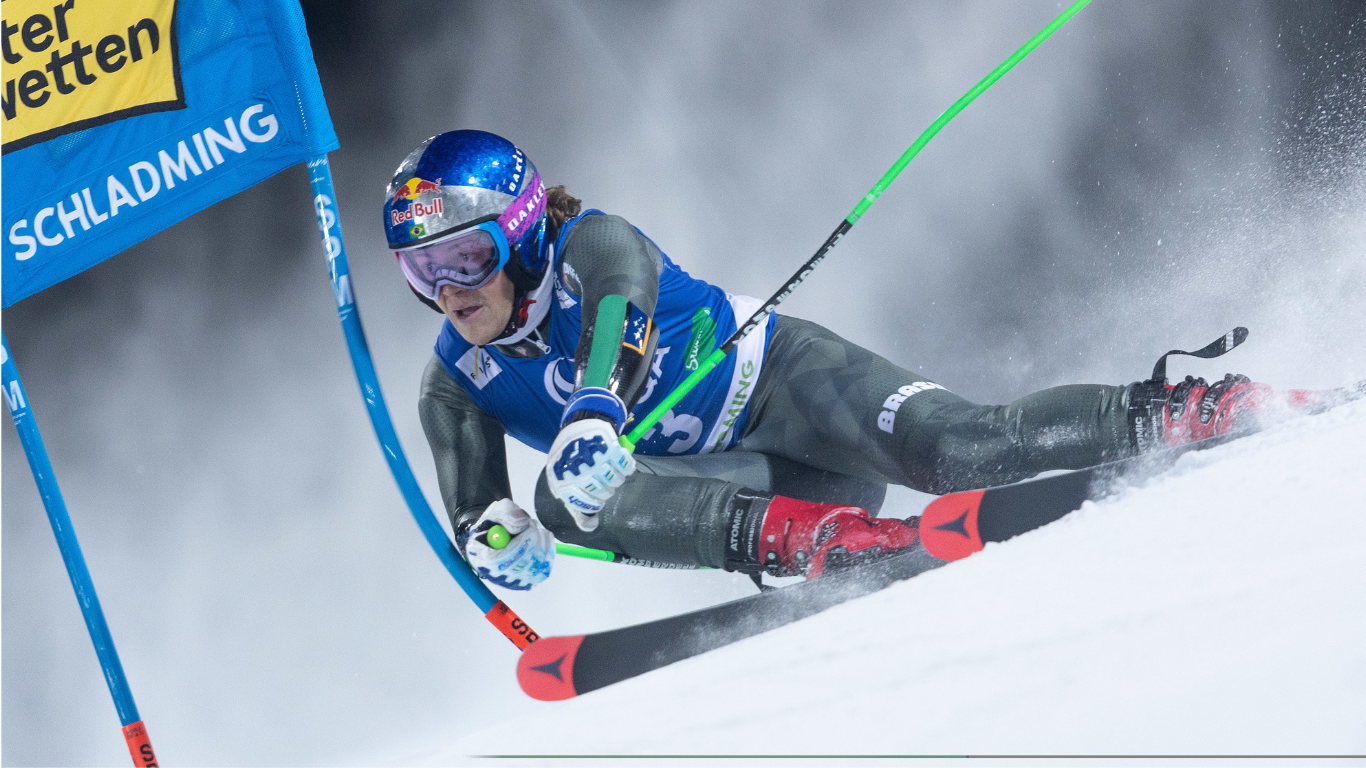
Lucas Pinheiro Braathen / GEPA pictures
This article is part of Ski Racing Media’s Rowmark Science Corner series.
Every coach has watched a young giant slalom skier throw the skis sideways at the top of the turn, only to lose speed before reaching the next gate. While that movement often gives athletes a greater sense of control, it comes at a significant performance cost. Understanding how energy is conserved—and how it is unnecessarily dissipated—is fundamental to helping young skiers become faster and more efficient.
In giant slalom (GS), managing energy is one of the most important factors in skiing fast. As a skier moves down the hill, gravity continuously converts potential energy into kinetic energy. The challenge for the athlete is learning to manage that energy without wasting it.
Energy dissipation refers to the loss of energy during a turn. While some energy loss is necessary to control direction, unnecessary energy dissipation reduces speed and limits performance. In GS, this energy loss occurs through ski-snow friction, snow deformation, ski deformation, vibration, and inefficient ski interaction with the snow. While energy dissipation is unavoidable to control line and direction, excessive energy loss is one of the main reasons young skiers struggle to ski efficiently and competitively.
Cost of Sliding the Turn
In many young skiers, turns are often initiated with a braking action rather than edge engagement and pressure control. While this may provide a sense of security, it comes at a significant performance cost. Every unnecessary slide or skid scrubs speed and interrupts the athlete’s flow through the course.
Every GS turn requires some energy loss to control direction. However, unnecessary sliding dramatically increases those losses, causing the athlete to exit the turn slower and work harder to regain speed before the next gate.
Differences Between Younger Athletes and Elite Skiers
One factor that separates fast skiers from slower skiers is how efficiently they manage energy throughout the turn cycle. Higher-level athletes aim to minimize sliding as much as possible because they understand that clean ski-snow interaction and proper release of the ski at the bottom of the turn allows energy to flow into the next turn.
Elite GS skiers:
- Establish the edge angle at the correct point of initiation
- Create pressure progressively
- Guide the skis through the turn rather than forcing them sideways
- Bring depth to the turn before engaging the new outside ski
- Reduce unnecessary friction with the snow
- Release the energy created during the turn, allowing momentum to flow toward the next apex
An ideal giant slalom turn is a continuous arc built from the top of the turn down. After creating sufficient depth, the skier establishes a clean carving platform before the skis enter the fall line. With balance already established during the transition, pressure builds progressively on the new outside ski through the top and middle of the turn. As the skier completes the bottom of the turn, the energy created throughout the arc is released, allowing momentum to flow efficiently toward the next initiation point.
Young athletes, however, often rely on defensive movements that cause excessive energy dissipation. Common examples include:
- Pivot or “steer” the skis abruptly at turn initiation
- Late pressure application
- Braking at the top of the turn
- Excessive upper-body rotation
- Beginning the turn too early, before creating sufficient depth
These movements eliminate the opportunity to build pressure efficiently, forcing the skier to recover below the gate rather than releasing into the next turn.
Why Efficient Energy Management Matters
Efficient skiing is not about eliminating all energy dissipation. Some energy loss is necessary to control the line and adapt to the terrain and course setting. The key is minimizing unnecessary losses.
When sliding becomes excessive:
- Speed decreases dramatically
- Turn shape becomes inconsistent
- Pressure management becomes more difficult
- Recovery between gates is limited
- Rhythm and flow are disrupted
Over time, habitual sliding and poor line choice can also limit technical development because athletes rely on braking rather than learning to manage pressure and edge control effectively.
Coaching Young Skiers Away From Sliding
Coaching Young Skiers Away From Sliding
While sports science helps explain concepts such as force production, ski-snow friction and energy dissipation, the challenge for coaches is translating these concepts into movement patterns and training environments that young athletes can physically understand and apply.
For coaches, one of the primary goals in GS development should be helping athletes reduce unnecessary distance traveled and improve turn efficiency. This begins with teaching athletes to create cleaner turn entries at the proper “depth” and establishing a stronger platform on the snow earlier in the arc.
Coaches often use visual and movement-based cues to reinforce these concepts. Terms such as “clean skis” and strong outside ski pressure” help athletes connect technical movement patterns with efficient ski performance. When paired with visual cues such as brushes, these coaching cues become easier for young athletes to understand and apply.
Training should focus on:
- Creating sufficient depth
- Pressure control
- Progressive movement into and out of the turn
- Strong stacked position and balance
- Understanding optimal apex placement
As athletes improve these skills, they learn to carry speed more effectively while still maintaining control of their line.
Conclusion
Developing these efficient movement patterns early is essential for long-term success in GS skiing.
To support this development, coaches must continue to explore progressive and engaging ways of teaching efficient ski-to-snow interaction. Traditional drills alone may not always create lasting change, particularly with younger athletes. By using terrain features, brushes, feedback technology and task-based learning—where athletes focus on mastering one objective at a time—coaches can help athletes better understand and feel the difference between energy-conserving and energy-dissipating movements. A more innovative coaching approach not only accelerates skill acquisition but also fosters greater athlete engagement and long-term development.
About the Author: Sean Sullivan