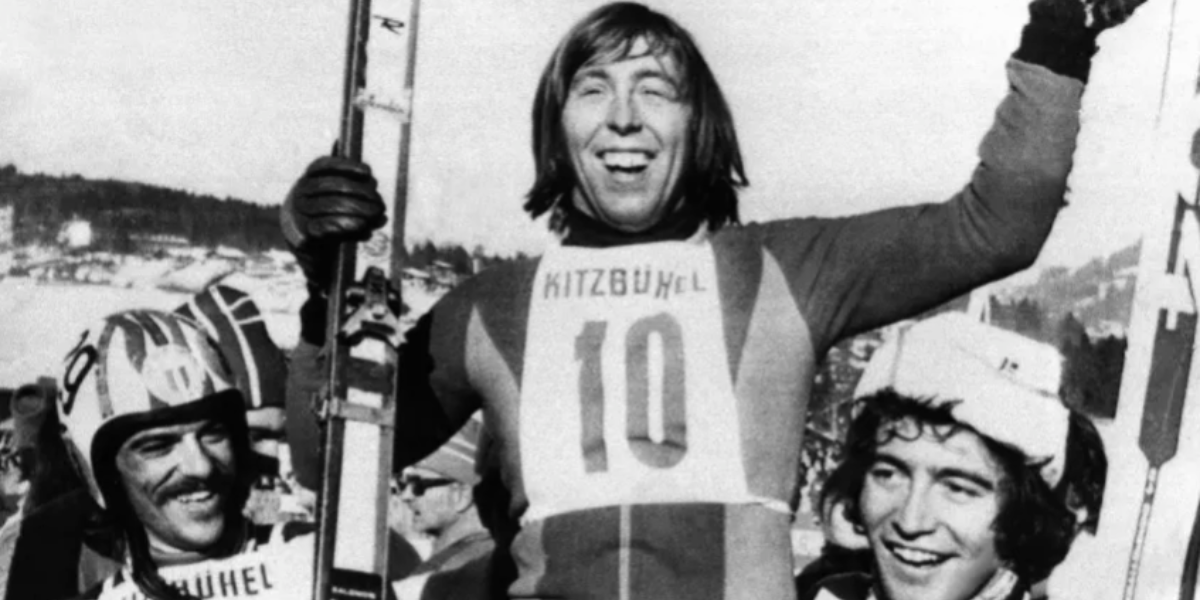
Roland Collombin celebrates his victory in the Kitzbühel Downhill, Austria, in January 1974. Photo: Keystone.
On July 10, Roland Collombin died peacefully at the home where he was born, surrounded by his family. He was 75.
The Swiss downhill great had fought cancer for two years. He was initially diagnosed with throat cancer before later developing liver cancer.
Collombin was born Feb. 17, 1951, in Versegères in the Valais region of Switzerland.
An Immediate World Cup Impact
At 20, Collombin made his World Cup debut in Val-d’Isère in December 1971. He immediately announced his arrival with a seventh-place finish in the downhill.
It was a remarkable start to his World Cup career. However, there was much more to come.

An Olympic Silver Medal
Later that season, Collombin competed at his first major championship. He won the downhill silver medal at the 1972 Sapporo Olympics, finishing behind close friend and Swiss teammate Bernhard Russi.
The unexpected medal established Collombin as one of the world’s leading downhill racers. It also became one of the defining achievements of his short but extraordinary career.
Downhill Dominance
During the 1973 and 1974 seasons, Collombin became a dominant force in World Cup downhill racing.
He won four World Cup races during the 1973 season, including victories in Val Gardena, Garmisch-Partenkirchen and Kitzbühel. Those results earned him his first World Cup downhill title.
A year later, Collombin was even more dominant. He won four consecutive downhills in January 1974 at Garmisch-Partenkirchen, Avoriaz, Wengen and Kitzbühel.
His victories on the Lauberhorn and Streif secured his place among the great downhill racers of his generation. They also helped him win a second consecutive World Cup downhill title.
Collombin represented Switzerland at the 1974 World Championships on home snow in St. Moritz. However, he did not finish the downhill.
Life-Changing Injuries
Collombin’s career changed dramatically before the opening downhill of the following season.
During training in Val-d’Isère in December 1974, he crashed heavily and injured his spine. The accident ended his 1974-75 season.
However, Collombin attempted to return to the World Cup one year later. During training in Val-d’Isère in December 1975, he crashed again at almost exactly the same place.
This time, Collombin broke two vertebrae and temporarily lost the ability to walk. The accident ultimately ended his remarkable downhill career at just 24.
The section of the Val-d’Isère course where the crashes occurred later became known as “La Bosse à Collombin” (“the Collombin roll”).
Collombin eventually walked again in February 1976. By then, the Innsbruck Olympics had taken place without him. Instead of pursuing another Olympic medal, he faced a long and difficult recovery.
A Remarkable Career Cut Short
The two crashes ended a career that appeared destined to produce many more victories.
Still, Collombin accomplished an extraordinary amount in only a few seasons. He retired with an Olympic silver medal, two World Cup downhill titles, eight World Cup victories and 11 podium finishes.
All eight of his World Cup wins came in downhill. He also recorded 14 top-10 finishes and placed third in the 1973 overall World Cup standings.
Collombin will be remembered as a fearless downhill racer who brought energy and character to a successful generation of Swiss skiers.
He was also one of the sport’s most colorful personalities. The Swiss press compared him to tennis star John McEnroe, while Swiss-Ski remembered him as unpredictable, spirited and unforgettable.
For Collombin, racing often appeared to be as much an adventure as a profession.
Life Beyond Ski Racing
After his racing career ended, Collombin built a full life away from World Cup competition.
He became involved in the wine business and later opened a raclette bar in Martigny. Fittingly, he named it La Streif after the Kitzbühel course where he won twice.
Collombin and his wife, Sarah, also operated a guesthouse in Versegères. Together, they had a son and a daughter.
Ski racer, Olympic medalist, wine merchant, bar owner, husband, father and grandfather — Collombin lived a life that extended far beyond his unforgettable years in downhill racing.
His victories made him one of Switzerland’s most celebrated racers. However, his personality, courage and love of life ensured he would be remembered for much more than results.
Ski Racing Media sends its deepest condolences to Collombin’s family, friends and former teammates.
[adsanity_rotating align=”aligncenter” time=”4″ num_columns=”1″ group_id=”5888″ random=”1″About the Author: Matt Garcka