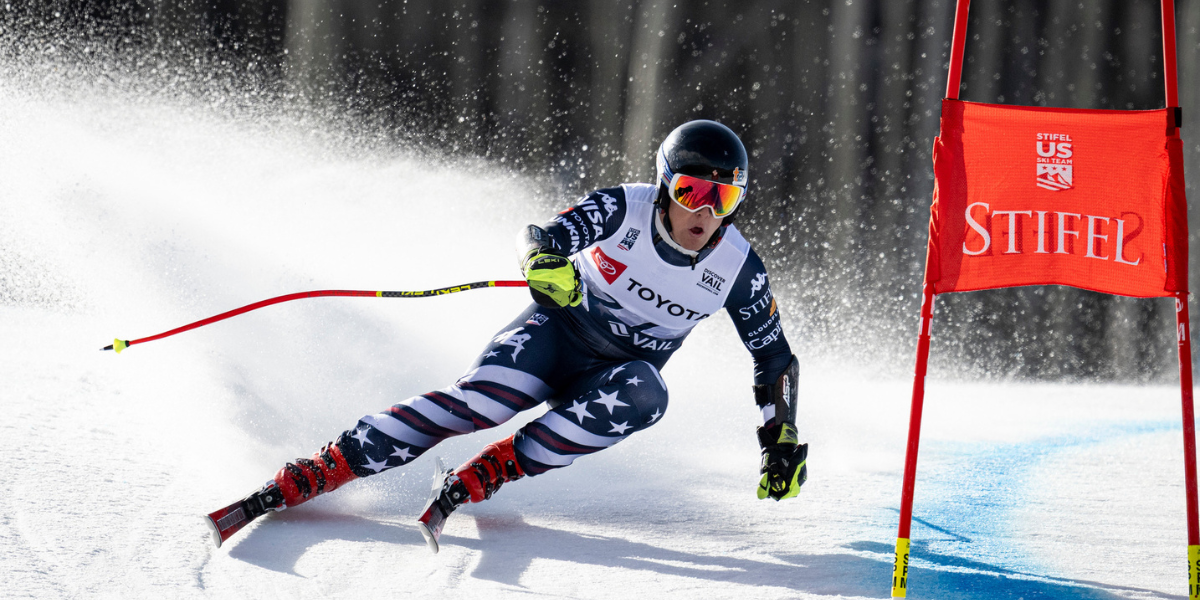
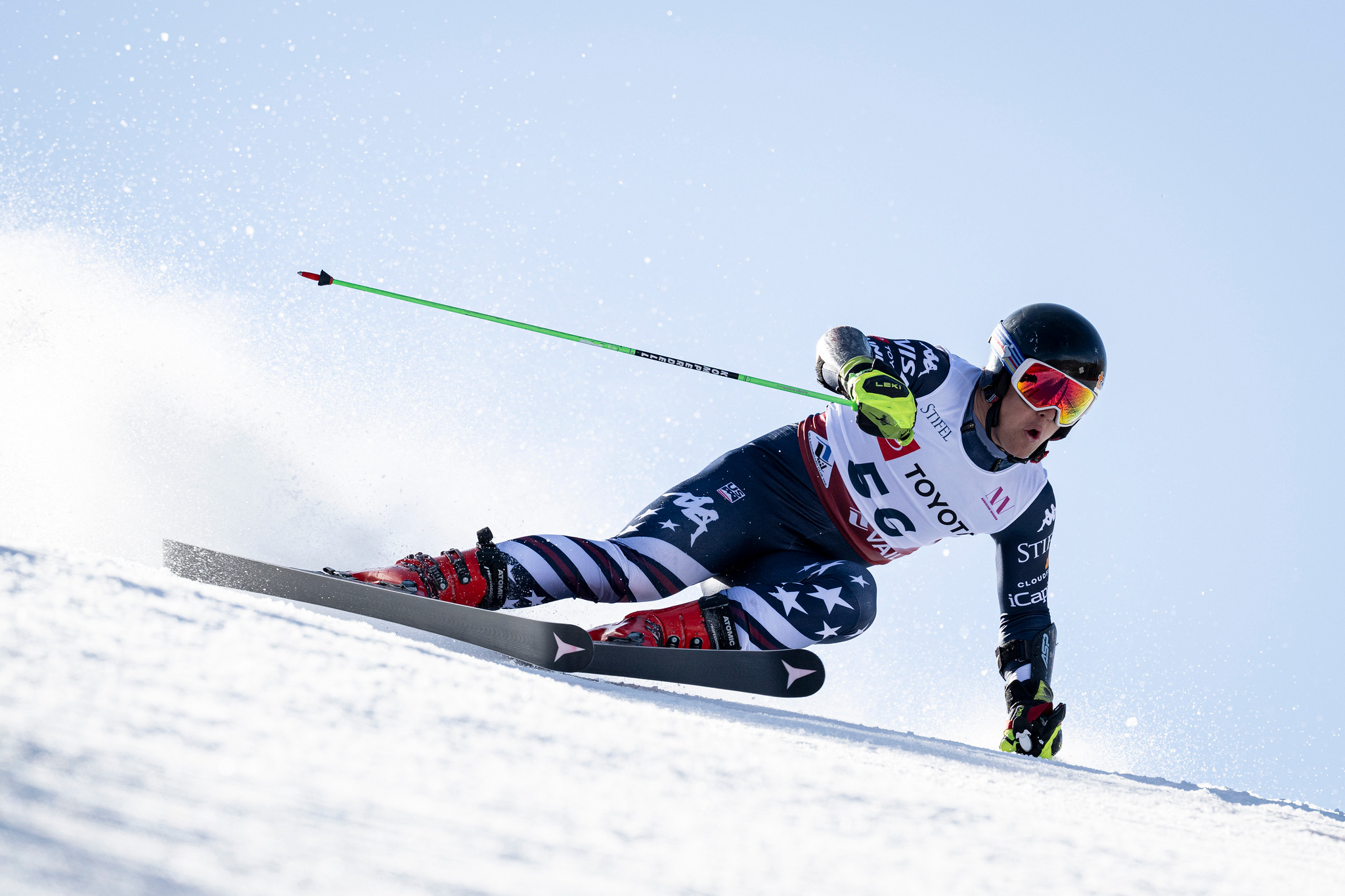
Mattias Wilson / Eric Brandolini media
After a breakthrough season that included strong NorAm results, a seventh-place finish at Junior Worlds and his first Europa Cup starts, the 19-year-old downhill prospect is beginning a new chapter with the national team.
Mattias Wilson does not have a complicated explanation for why downhill has become his strongest discipline.
The 19-year-old is ranked No. 100 in the world and has earned two top-10 finishes in speed events at the FIS Alpine Junior World Ski Championships. Still, when asked why he has developed into one of the country’s most promising young downhillers, Wilson does not pretend to have every answer.
“I don’t really know,” Wilson told Ski Racing Media. “A lot of people ask me that question.”
The explanation may be easier to see from the outside.
Wilson grew up in Jackson Hole, Wyoming, surrounded by steep terrain and a family that loved skiing. Long before he began thinking seriously about results, he learned how to move through one of North America’s most demanding mountains.
Now, after earning a nomination to the Stifel U.S. Ski Team, Wilson is preparing to find out how far that foundation can take him.

A childhood built around Jackson Hole
Wilson grew up near Jackson Hole Mountain Resort. His father was an enthusiastic skier who had also been raised in the area, and Wilson’s grandparents owned the hostel at the base of the resort.
Skiing was part of the family.
“My dad’s a big skier,” Wilson said. “He grew up here.”
Wilson spent much of his childhood in the resort’s Kids Ranch program. His father also occasionally pulled him out of school when fresh snow arrived.
He did not begin as a racer. Instead, Wilson first learned by exploring the mountain and becoming comfortable on its demanding terrain.
He estimates that he joined the Jackson Hole Ski & Snowboard Club when he was 10 or 12. He then spent at least eight years with the program.
“I credit a lot of my skiing to my dad,” Wilson said.
Several coaches also helped him remain engaged in the sport. Kevin Keane played an important role during Wilson’s U14 years and again when he entered FIS competition. Wilson also credits former U16 coach Ned Lazarevic with helping him continue racing through a critical stage of his development.
However, the mountain itself may have provided his most lasting education.
Jackson Hole taught Wilson to read terrain, adjust to changing conditions and remain comfortable while carrying speed.
A national title at home
One of Wilson’s most meaningful early results came on familiar terrain.
On March 8, 2024, he won the U18 national super-G championship at Jackson Hole Mountain Resort.
The title remains one of the results he values most. It mattered not only because it came at a national championship, but also because it happened on the mountain where he learned to ski.
“Result-wise, I think winning the U18 super-G at Jackson was pretty special just because it was at home,” Wilson said.
The victory also offered an early indication that Wilson could produce his best skiing when the stakes were high.
That pattern has continued.
A calculated move to Sugar Bowl
Wilson completed high school in Jackson. During his final three years there, he also spent part of each season training with Sugar Bowl Ski Team & Academy.
After completing three FIS seasons with the Jackson Hole Ski & Snowboard Club, Wilson moved to Sugar Bowl for his fourth year of FIS racing. He joined the California program full-time as a postgraduate athlete.
The move came at an important stage in his development. Wilson valued what Jackson had given him, but he believed he needed a more structured racing environment to reach the next level.
“It wasn’t an environment where I felt like I could succeed at the next level,” he said.
Sugar Bowl offered something new while still feeling familiar.
Wilson already knew athletic director Branko “Bronco” Zagar from his time in Wyoming. He was also familiar with coaches Matej Vidović and Matilda Sola through Western Region racing.
More importantly, Wilson believed the staff had a clear plan.
“They were really dialed in,” he said. “It just seemed like they knew what they were doing, and they had a plan. I bought in on that plan, and I think it worked out quite all right.”
Wilson’s postgraduate season helped him turn potential into consistent results. He also developed close relationships with his coaches and teammates.
“Having my two coaches last year, Matej and Matilda, and being very close and connected to them was very strong,” Wilson said. “Being able to rely on them if stuff doesn’t go the greatest was a nice benefit.”
The results that changed everything
Wilson entered last season with national team ambitions. However, the possibility became real during the speed races at Aspen Highlands.
He had already shown encouraging form at Whiteface Mountain. Wilson struggled on the upper part of the course but gained time on the flatter lower section.
His ability to carry speed made the difference.
“A lot of people say I’m a natural glider,” he said.
By the time he reached Aspen, confidence had become equally important. Wilson produced the second result he needed to satisfy the Stifel U.S. Ski Team nomination criteria.
“After Aspen, after I got that second result, I basically knew I was going to make the team,” he said.
Vidović then sent a congratulatory message to the Sugar Bowl group chat.
Even so, Wilson did not allow himself to fully celebrate until U.S. Ski & Snowboard officially announced the team.
“It felt really good,” he said. “I didn’t really take it in until it was officially announced.”
Entering the national team environment
Wilson has already attended his first on-snow camp as a Stifel U.S. Ski Team athlete.
The Copper Mountain camp focused heavily on giant slalom. Wilson worked with Europa Cup coaches Mike Bansmer and Francio Bertolini on tactics and technical development.
Arriving as a national team athlete felt different.
“It was definitely a surreal feeling,” Wilson said.
However, he quickly became comfortable within the group.
“It feels like a very nice family,” he said. “I feel like a lot of productivity is to be had.”
Wilson also spent more than a month in Park City. That stretch included rookie camp, additional conditioning work and the joint men’s and women’s national team fitness camp.
Training alongside more experienced athletes gave him a clearer view of the physical standards required at the next level.
“It’s nice to train with them and see how strong they are and see where I need to be,” Wilson said.
He also believes shared camps can strengthen the team’s culture.
“You need a culture and a team to progress,” he said.
Why downhill works
Although Wilson cannot fully explain why downhill has become his best discipline, he understands why the event appeals to him.
Downhill rewards preparation and repetition. Training runs allow athletes to study the course, refine their line and learn how each section should feel.
That process suits Wilson.
“I like downhill a lot because you get to run the course multiple times and really learn,” he said. “Knowing where I need to nail certain spots is definitely helpful.”
Wilson admits he sometimes struggles to find his best skiing immediately, particularly in the opening run of a technical event. Downhill training gives him time to understand the track and build confidence before race day.
Gliding is another clear strength. However, Wilson believes confidence may be his most important asset when he is skiing well.
“I believe anyone can win on any day,” he said. “It just depends on how confident you are attacking a certain hill, a certain turn or certain sections of a course.”
Wilson also knows where he must improve.
Airtime is one area of focus.
“My airtime is usually pretty scary,” he said. “I’m definitely not the best in the air, but I need to work on that.”
More broadly, Wilson wants a technical foundation he can repeat under different conditions and levels of pressure.
“If I can really dial in a technical foundation that I can repeat over and over again, I think I’ll be able to work on other things as well,” he said.
A first look at Europa Cup racing
Wilson received his first Europa Cup opportunities while in Norway for the Junior World Championships.
The experience showed him the depth and quality of the next level.
“It’s definitely a high level,” he said.
Wilson did not finish either race. He believes nerves affected his execution and caused him to rush his skiing.
Still, he saw enough to believe he could compete.
“I was definitely close to having maybe an OK result there until I DNF’d,” he said.
The races also clarified what he must improve.
“I try to focus on my tactics, my line and staying calm,” Wilson said. “I rushed myself a little too much, and it bit me.”
Wilson hopes to earn more Europa Cup opportunities this season. Those starts would allow him to face stronger fields and gain experience on courses that also host World Cup races.
“Any time down a World Cup track is very important if you want to continue to be a speed skier,” he said.
Delivering at Junior Worlds
Wilson has represented the United States at three Junior World Championships.
In 2025, he finished 10th in the downhill in Tarvisio, Italy. This year, he placed seventh in the super-G in Narvik, Norway, after poor weather forced organizers to cancel the downhill.
The cancellation was difficult for Wilson. He had arrived prepared to compete in his strongest event.
“It was pretty disappointing,” he said. “I was ready to race, but it got canceled. So, what are you going to do? Move on to the super-G and try to ski my best.”
Wilson was not satisfied with every part of his seventh-place run. However, the result gave him a second top-10 finish at a major international championship.
He believes the key is learning to treat important races like any other day on snow.
“A big focus this year with my coaches was trying to attack every single training day and every single race day as if it was just another day out skiing,” Wilson said.
That approach helps him manage the pressure he places on himself.
“Nerves are inevitable, but they’re also good,” he said.
Another opportunity at Whiteface
Wilson has one season remaining as a junior. If he qualifies again, he will compete at the 2027 FIS Alpine Junior World Ski Championships at Whiteface Mountain in New York.
The event offers a rare opportunity to race a world championship on home snow.
Wilson has already performed well at Whiteface and hopes that experience will become a source of confidence.
“I think it’ll definitely give me some confidence if I use it that way,” he said.
He also knows where he can improve. His previous Whiteface performances were stronger on the lower part of the course.
“I hope to clean up the top so I have a chance at doing even better,” he said.
The location may also allow more family members to attend. Wilson’s mother has traveled to each of his previous Junior World Championships. This time, his father and relatives in the Northeast may also have the opportunity to watch.
Building toward the season
Wilson’s preseason will include extensive time in South America.
The Stifel U.S. Ski Team plans to begin with a training block in Ushuaia, Argentina. After a short period at home, Wilson expects to travel to Chile for approximately a month.
The schedule includes additional training and planned South American Cup races at La Parva and Corralco.
Wilson wants to arrive at the opening NorAms with a stronger technical foundation and movement patterns he can reproduce every day.
“I want a really strong technical base and something I can repeat every single training day and every single race day,” he said.
His primary competitive goal is ambitious. Wilson wants to challenge for the NorAm downhill season title and earn more opportunities in Europe.
“I think my goal is to try to win the downhill season title, but at least be top two,” he said.
A downhiller who loves slalom
There is one final detail that complicates the obvious description of Wilson as a speed specialist.
Downhill may be his best event, but it is not his favorite.
That distinction belongs to slalom.
“Slalom is definitely my favorite discipline, even though I have excelled in downhill,” Wilson said. “I tell everyone that.”
He enjoys the variety of successful styles in slalom and the possibility that athletes can produce speed in different ways.
Wilson plans to continue racing the event, particularly during his final season as a junior.
The choice reflects a broader part of his personality. He does not want to limit himself too early. Instead, he wants to strengthen his technical skiing, continue improving in speed and take advantage of every opportunity the season offers.
His path has already taken him from Jackson Hole’s demanding terrain to Sugar Bowl, Junior Worlds, Europa Cup racing and the Stifel U.S. Ski Team.
For younger racers hoping to follow, Wilson’s advice is simpler than his journey.
“You just have to have fun,” he said. “Ski racing is really hard, and it’s not easy for anyone. You and your teammates need to be able to lift each other up.”
Wilson learned to ski on a mountain that demanded confidence. He then found coaches and teammates he could trust.
When the results mattered most, he was ready to let the skis run.
About the Author: Peter Lange