Featured Image: Julia Scheib.: GEPA pictures
In October, Julia Scheib captured third place in Sölden, ending the five-year Austrian giant slalom World Cup podium drought. And on Dec. 28, she’ll be ready to take on the established World Cup elite in Semmering, Austria. In an exclusive interview with Ski Racing Media, the friendly 26-year-old with a fierce racing style reflects on her early-season experiences, goals, and demanding journey that has led to her current position.
Rollercoaster Race
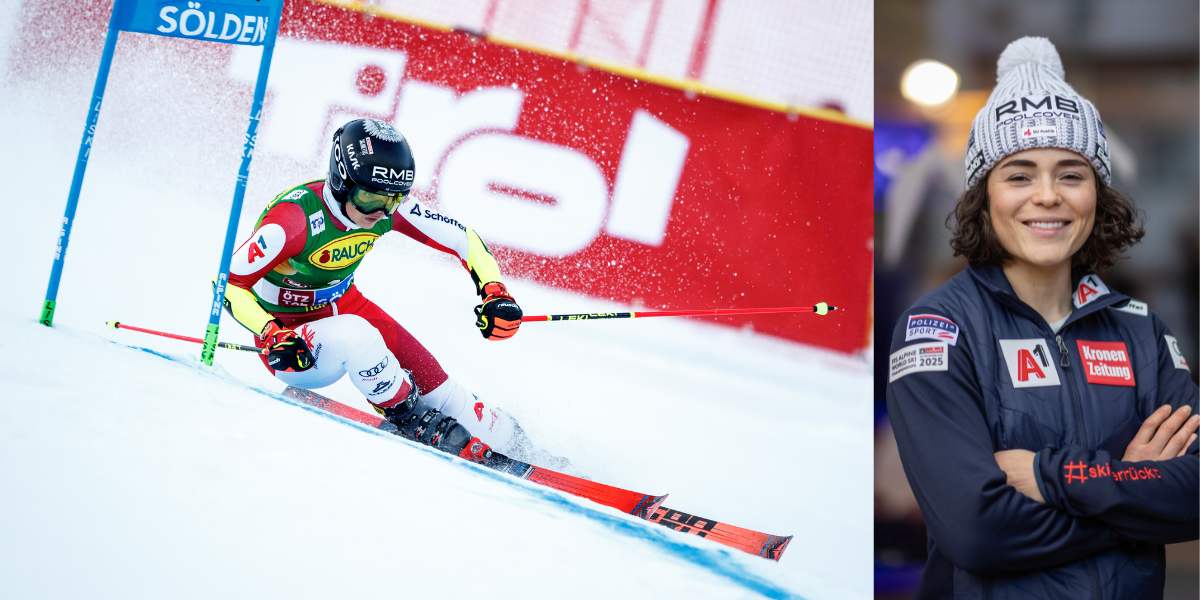
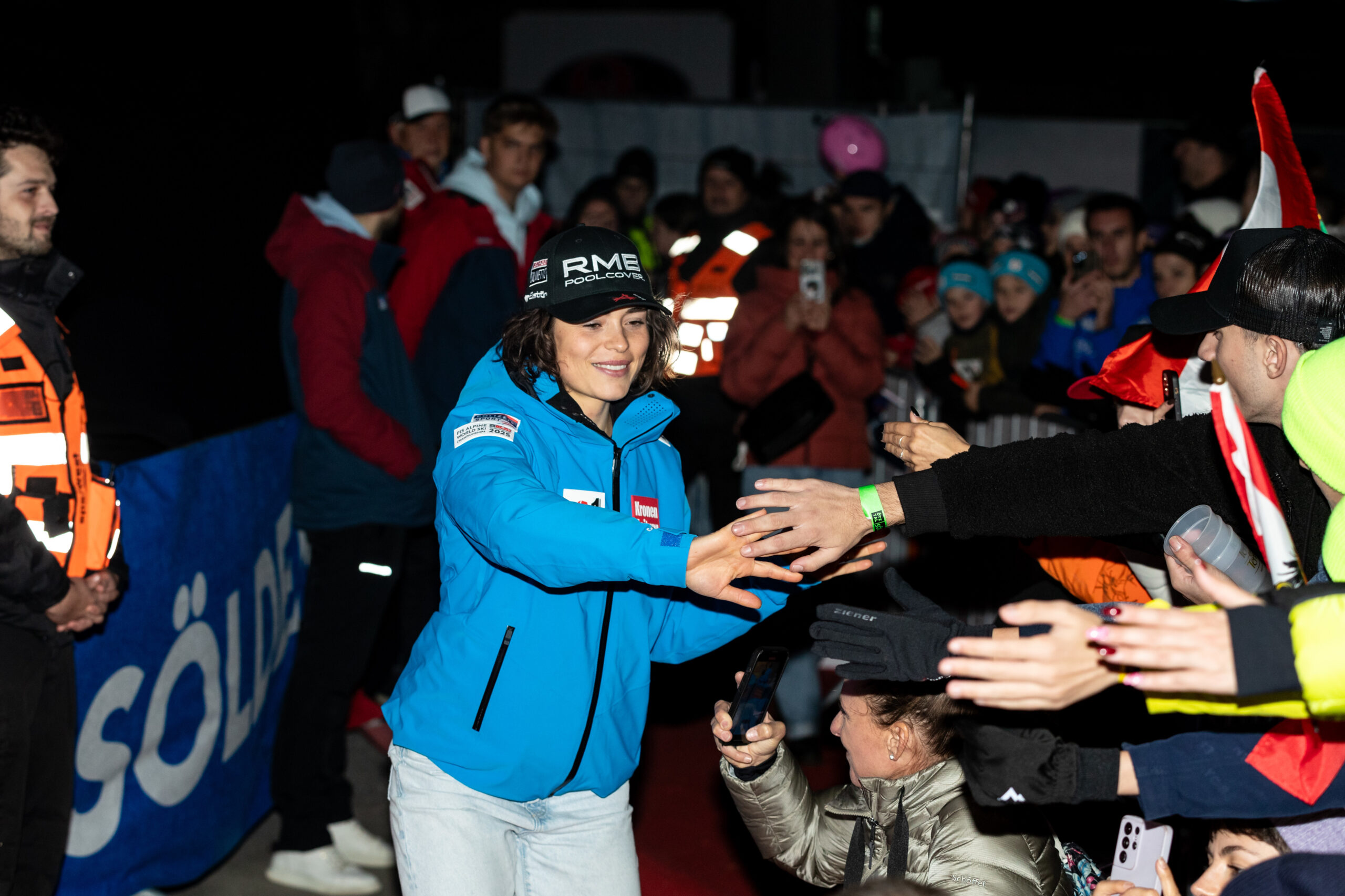
“That race, yes, a rollercoaster of feelings,” Julia Scheib says when asked to describe the race day in Sölden on Oct. 26. She captured her first-ever World Cup podium in front of an excited, record-breaking Austrian home crowd.
“I was really confident at the start gate in the first run. I had a clear mindset, a clear plan how I wanted to ski—and I thought it was over after 12 seconds.”
Scheib made a significant mistake when coming over a roll and aiming in the wrong direction early on. “I saw the wrong gate and lost time there but told myself I had to keep going, not think about the mistake and do my best.
“Between the runs, it was not easy for me because of this mistake.” She thought, “It’s over. Every athlete would think, ‘Okay, it’s over for this race, no chance.’”
But she doesn’t give up: “Even when I make mistakes in the first run, I’ve always been very focused in the second, no matter what happened. So, in this case, I was really focused again to try my best, to show my best skiing, because my skiing was really good at this point of the season.
“It ended up with a podium and it was crazy, crazy, unbelievable,” she shares, soft-spoken but excited.
Click on images to enlarge

Top 10
Over the past few years, Scheib has worked her way into the top 10 in the giant slalom. Last season, she recorded five top-10 results, including fifth-place finishes on home snow in Lienz and Saalbach, Austria.
She is now ranked 10th on the World Cup Start List, entering the third giant slalom competition of the season.
However, with three DNFs and one DNQ during last season’s 11 World Cup giant slalom competitions, she still has work to do.
What does Scheib view as her strengths as a skier, and what does she need to improve?
“I think my weapon is my turn. My turn is really fast, and I have to learn to handle it to be more consistent.”
She further explains, “When I was younger, I had a lot of DNFs, also in training. I had a plan, but I was a young racer, you know? Just [wanted to] go skiing, and when I trained, I wanted to ski fast and not have eight runs in the finish as a goal.”
That was then. Now, she has changed her focus.
“[During] the last years, it has been important for me to be really strong but also to finish the runs without any mistakes. It is important to have this in the training because when you don’t have it in the training, you can’t expect to have it in the race,” she says with a chuckle.
Killington Struggles
Despite starting the season on the podium, Scheib had a difficult time in the second giant slalom race, which resulted in a DNF in Killington, VT, on Nov. 30.
When arriving in the USA in November, Scheib and her Austrian teammates trained in Copper Mountain on dry Colorado snow.
However, the Copper Mountain snow was incompatible with the race surface in Killington, where the organizers added water to the race hill snow. Scheib says, “We knew that, but it was totally different.
“We had no time and no chance to try any setup, and it was like, ‘Okay, we go for it, but we don’t know what will happen.’ So, it was not easy, and in Killington, I really had no chance to see the finish line with the setup.”
Adjustments after the DNF were helpful in the upcoming days: “I talked to my service guy, and we had super training days after the race. It was two days too late, but the training days were excellent, with a good setup, with good grip, and good times.”
The World Cup schedule also included races in Tremblant, Canada. However, their lack of snow led to race cancellations. Instead, Scheib and other Austrian giant slalom teammates returned home at the start of December.
Home-Race Excitement
It’s now time for Scheib’s home race in Semmering—located only an hour-and-a-half drive from her hometown Frauental an der Laßnitz and a similar distance from her current home near Graz.
A lot of people she knows will come and cheer for her:
“All the family, friends, and people I have not heard from for a long time. That’s really cool, and I hope I can show fast skiing, and I hope for a party after the race,” Scheib shares with excitement.
Leading up to the World Cup in Semmering, the Austrian women’s giant slalom team trained on home snow, mainly in Reiteralm. However, because their cargo was delayed in New York, USA, on its way back from the North America tour, the team had to start the training period with back-up skis and boots instead of their best gear.
Scheib and her teammates also enjoyed a short Christmas break before the final on-snow preparations on Dec. 26-27.
Expectations and Pressure
Being a member of the SkiAustria National Team is an honor in a country where alpine skiing has traditionally been the nation’s number one sport. However, the position and visibility in the Austrian media also add pressure.
Scheib’s third-place finish in Sölden was the first giant slalom World Cup podium by an Austrian woman since Katharina Liensberger placed third in Lienz in December 2019.
Due to the lack of top results, the situation for the Austrian giant slalom women has been challenging and stressful during the past few seasons. Did this affect Scheib’s motivation coming into the season? Did it make it more difficult or inspire her to do well?
“Good question,” Scheib responds. “The situation was, for sure, not easy for us, especially for me because I heard so often that I would be the one to do the next podium, and then I also had a lot of not-so-good races during previous years.
“It was really hard to find my middle [intensity] and also my easiness [in my skiing] because I was always fast in training. It is not easy to bring it into the races.”
Media Coverage
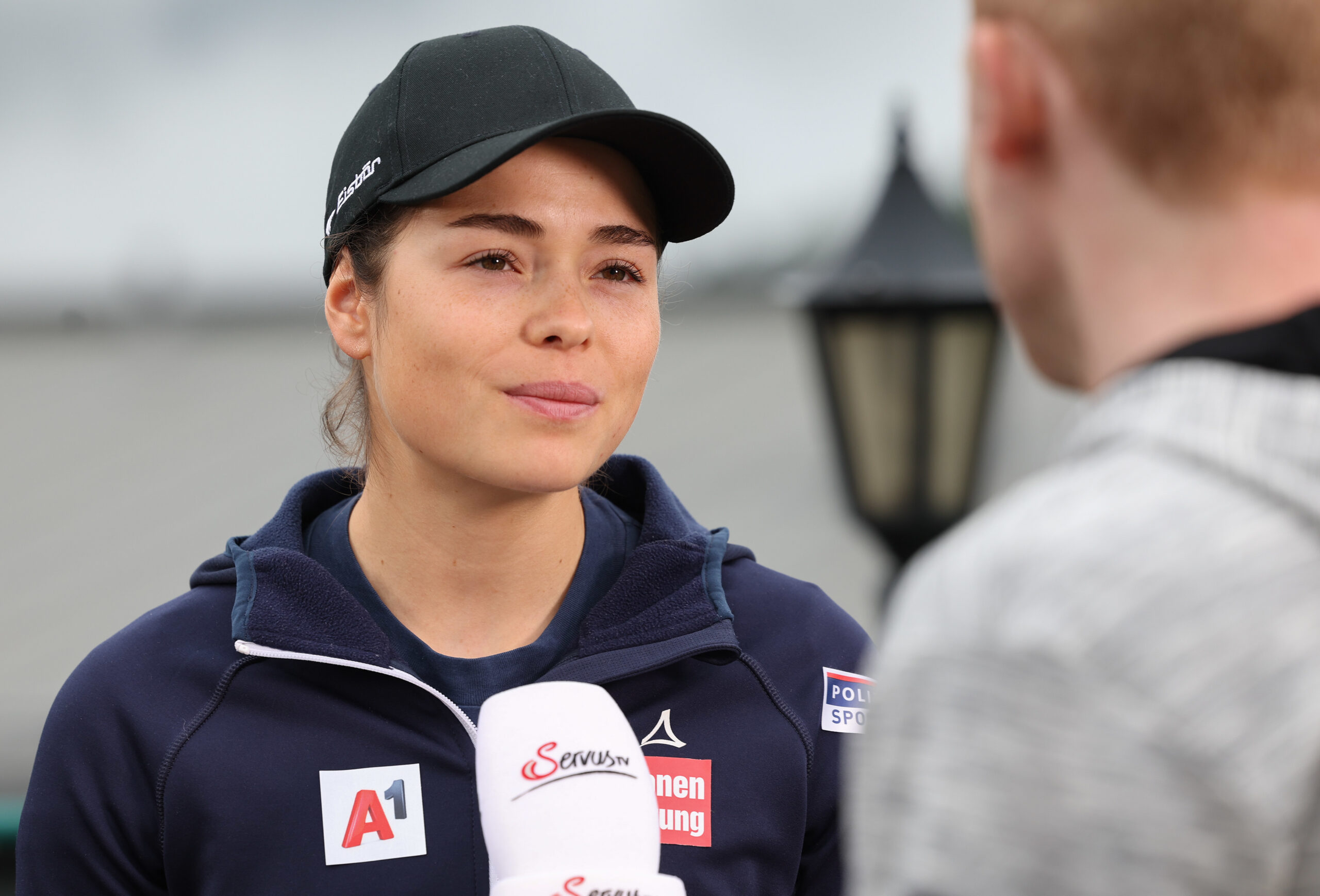
Scheib says the situation with Austrian media coverage “is never easy.” After this year’s giant slalom race in Killington, the media coverage returned to the usual level from the past few years, Scheib states.
“So, I think the one podium in Sölden doesn’t change anything because the media wrote the same things after Killington, where we had a not-so-good race. But I think, as athletes, we have to deal with it. It is what it is, and we all try our best. We all want to ski fast and show a good race. I think, at this point, we must deal with it.”
Medals and Glory
There have been good reasons to celebrate Scheib’s results in the past:
In February 2016, she won the super-G silver medal at the Youth Olympic Winter Games in Lillehammer, Norway.
Two seasons later, in 2017/18, she started in her first European Cup and World Cup races, and won the gold medal in giant slalom at the 2018 FIS Junior World Ski Championships in Davos, Switzerland.
The successful results continued in 2018/19 when she captured her first European Cup victory and scored her first World Cup points (24th in giant slalom at Maribor, Slovenia). Also, in February 2019, Scheib won another medal in the FIS Junior World Ski Championships, a silver in super-G in Val di Fassa, Italy.
Scheib quickly moved up the ranks in the Austrian Ski Federation (ÖSV) team system. She became a member of the ÖSV Development team from the 2014/15 season before qualifying for the ÖSV 2017/18 B-team. Then, starting with the 2018/19 season, she is a member of the ÖSV (now SkiAustria) World Cup giant slalom team.
The Battles
However, her skiing career hasn’t been the easiest path. Like other unfortunate alpine ski racers, Scheib has suffered two knee injuries, in 2016 and 2021, and undergone several surgeries. Additionally, she has fought—or rather, had to rest through—a tough battle with mononucleosis in September-November 2019. The illness affected her stamina and training during the following season. A bout with Covid also took its toll in November 2020.
After tearing her ACL in early February 2021, she missed most of the winter and the entire 2021/22 season.
Scheib finally returned to World Cup racing in the 2022/23 season, starting with two DNQs at her home races in Semmering in December 2022. Next, three top-15 results followed in January 2023.
How has she stayed strong and endured these long breaks with injury, illness and rehab?
Darkness
“There was a time when I was not strong,” Scheib replies honestly. “I was in a dark place because the second ACL injury in 2021-2022 was the toughest period. The knee was not good for a really long time, and I was not sure if it ever would be well again.
“I did not think about skiing anymore; I just thought I wanted to walk normally and go mountain biking. But this was also not possible for a long time.”
In September 2021, during the tough times, Scheib posted these motivational words on Facebook:
“The past is your lesson. The present is your gift. The future is your motivation.”
Was this her typical way of thinking and how she felt motivated?
“Yes, absolutely,” she says, explaining that her family was the most important support for her at that time. “Without them, it would not have been possible to think like this.” Her family motivated her and helped her think positively during the most challenging periods.
Step by Step
During the long and demanding rehabilitation process, Scheib believed she would never again manage to ski well.
Luckily, her knee strengthened, and she found motivation knowing she could ski fast. She started to prove this in training.
“Then, step-by-step, it was a really long process—with a happy ending, for sure,” she says.
Loving Super-G
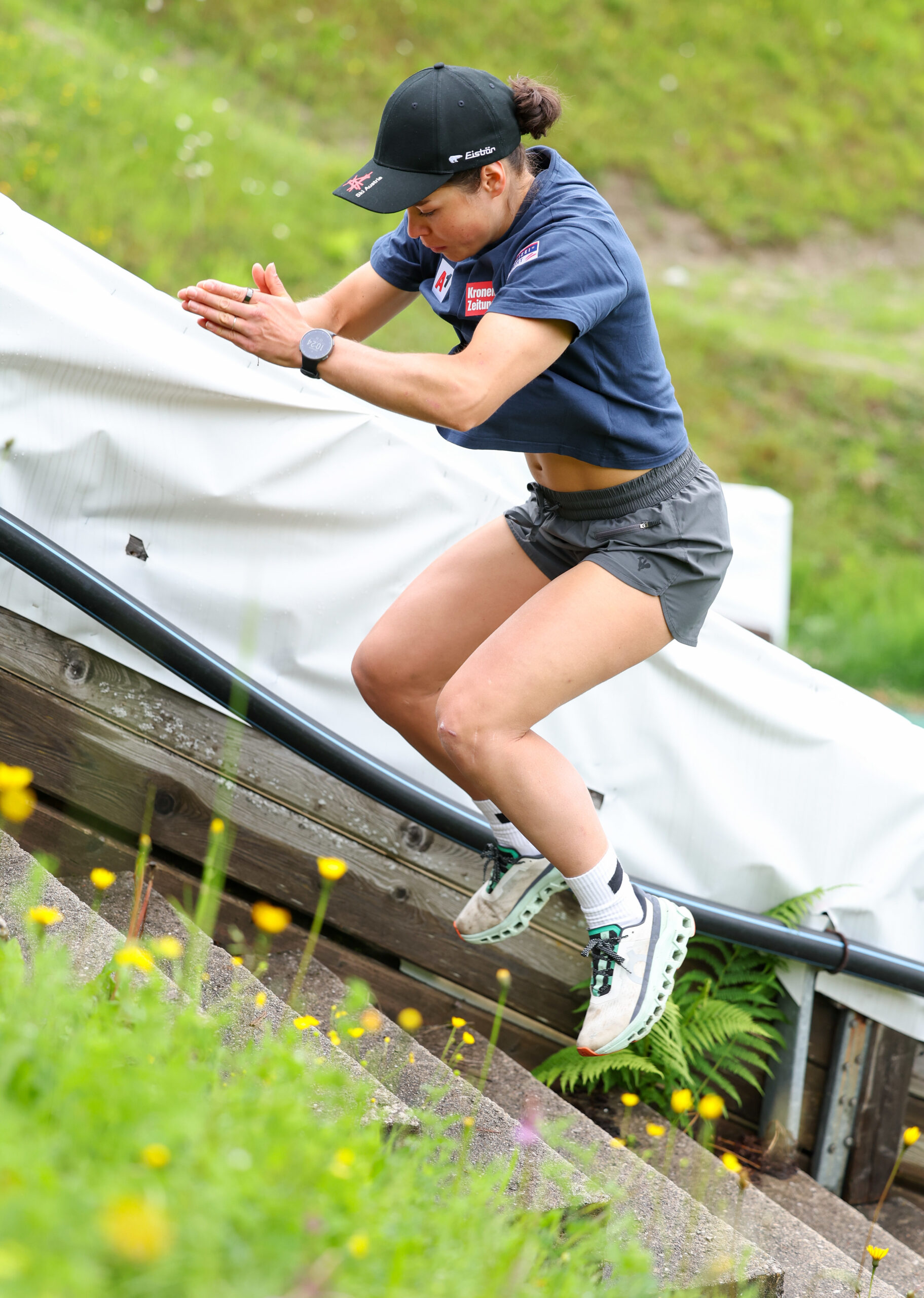
Now, Scheib is focused on giant slalom. However, with her past successes, she would like to add super-G to her World Cup repertoire.
“I absolutely love to ski super-G! And I know I can ski fast because GS and super-G are similar in a way,” Scheib says excitedly. Even so, when racing for Austria, you can’t just step into another World Cup discipline whenever you’d like.
“In past years, it was not easy to get a spot in the Austrian [super-G] team because there are a lot [of Austrians] in the top 30. The speed trainers want their athletes in the race, so it’s not easy for a slalom racer or a GS racer to get a spot,” Scheib explains.
While Scheib raced super-G in several European Cup and FIS competitions last season, reducing her FIS point from 40.98 to 28.41, and currently ranks 70th in the world, competition for a starting spot in the World Cup is fierce. Five Austrian women rank in the top 30 in super-G on the World Cup Start List, led by Cornelia Hütter in second. Others follow close behind, including several ranking in the early 30s.
Once again, Scheib will work on a challenge step by step: “We will train super-G, see how my shape is, and then we will make a plan.”
Season Goals
What are her thoughts for this season and the upcoming FIS World Championships on home snow in Saalbach-Hinterglemm, Austria?
“I am so excited! But I want to think from race to race, so the next race is Semmering, Austria—that’s really cool!
“Then, slowly but surely, the World Championships are coming, and that is the biggest goal for the season,” she says.
Her other goal is to ski well and score as many points as possible in every World Cup race.
“For the next years, the giant slalom globe is the biggest goal; to be the best in the whole season in giant slalom. I think that is the highest award you can get for a skier. To become an Olympic champion or to win the gold medal at the World Championships is so special. [But] the globe is honoring the best during the whole season, so that’s the highest goal.”
Scheib’s determination and strengthened self-confidence shine brightly:
“I know that with two good runs, I can beat everyone.
“But I don’t want to have [the globe] so present in my mind. I want to look from race to race. Killington was a disaster, but we analyzed it and learned a lot from it. I think Semmering will be totally different. We’ll prepare really well, and I want to ski really well,” she confidently says.

Who is Julia?
When asked to describe herself, Scheib says it wouldn’t be easy to do so in German, implying that it is even more complex when being interviewed in English.
She shares, “I think I’m sometimes quiet but can also be the opposite. I’m a hard worker. I also love to work towards my goals. I love to cook, I love to be in the garden, and I love to get a lot of me-time.”
Scheib shows compassion towards people around her. She participates in charity campaigns, and on social media, she promotes the importance of being considerate of others, for example, during the past Covid pandemic.
Last February, she found time to visit her old elementary school and kindergarten during their school ski race, which excited the young students and staff.
During her visit, she gave her original Kronplatz World Cup bib to her old school.
Scheib explains the joy she feels in these meetings with others:
“Next to being a successful skier, it’s the most beautiful thing of my journey. It was so nice to see the young kids and to motivate them to do sports.
“It doesn’t mean you have to go outside to ski. They have to find their sports for themselves. The children were cool; they really had that glow in their eyes. It was so nice to visit them. I love this part of being a professional athlete.”
Young Skier from Frauental
How did her ski racing adventure begin? Scheib’s hometown, Frauental, is in Styria, one of Austria’s nine federal states. While hillsides flank the town, it is best known for its beautiful flowers and grapevines than for producing world-class ski racers.
Luckily for young Julia, the small, one-run ski area Kluglifte Hebalm, is located in the nearby forest-covered, rounded hills. Her parents, Sylvia and Heribert, introduced her to alpine skiing when she was 2.5 years old, and they were also members of the hometown ski club.
On her website, juliascheib.at, she describes herself as wearing pink overalls and a balaclava. While her first skiing attempt was a “slippery affair,” she soon found great joy in skiing wavy tracks and forest trails.
At age four, her parents and brother Michael encouraged her to enter her first ski race, which she won.
“I think I fell in love with skiing from the first moment on—step by step, from kids’ races to youth races. I just always loved skiing,” she tells Ski Racing Media.
No Mountain Needed
Scheib wants people to know that “you don’t need a big mountain in front of your house to follow your dreams.” Her small home ski area was enough for her as a young girl, and the smaller ski areas are good starting points for many.
“At the Kluglifte, there’s just one slope, and you can do a lot of runs in one session. I was the only one training on the hill, maybe with one other guy.” The training at the tiny home area was easily accessible for Scheib, and thinking back brings fond memories:
“Also, my dad or my mom were there often, and it was a beautiful time.”
When asked to name her fondest ski racing memory through the years, Scheib will not pick one:
“There are so many. At that moment, [the experience] is so special and so unique, so I don’t want to pick one.”
Don’t Listen!
Now, Scheib looks towards the future and is entirely focused on her Dec. 28 home race in Semmering. As she aims to show her best skiing in one race at a time, with a World Cup giant slalom globe as her eventual goal, she parts with the following advice for young skiers:
“Do what makes you happy. Follow your dreams. And when there’s someone who says, ‘Hey, you can’t do this,’ and ‘You’re not good enough,’ don’t listen!”
About the Author: Bente Bjørnsen Sherlock