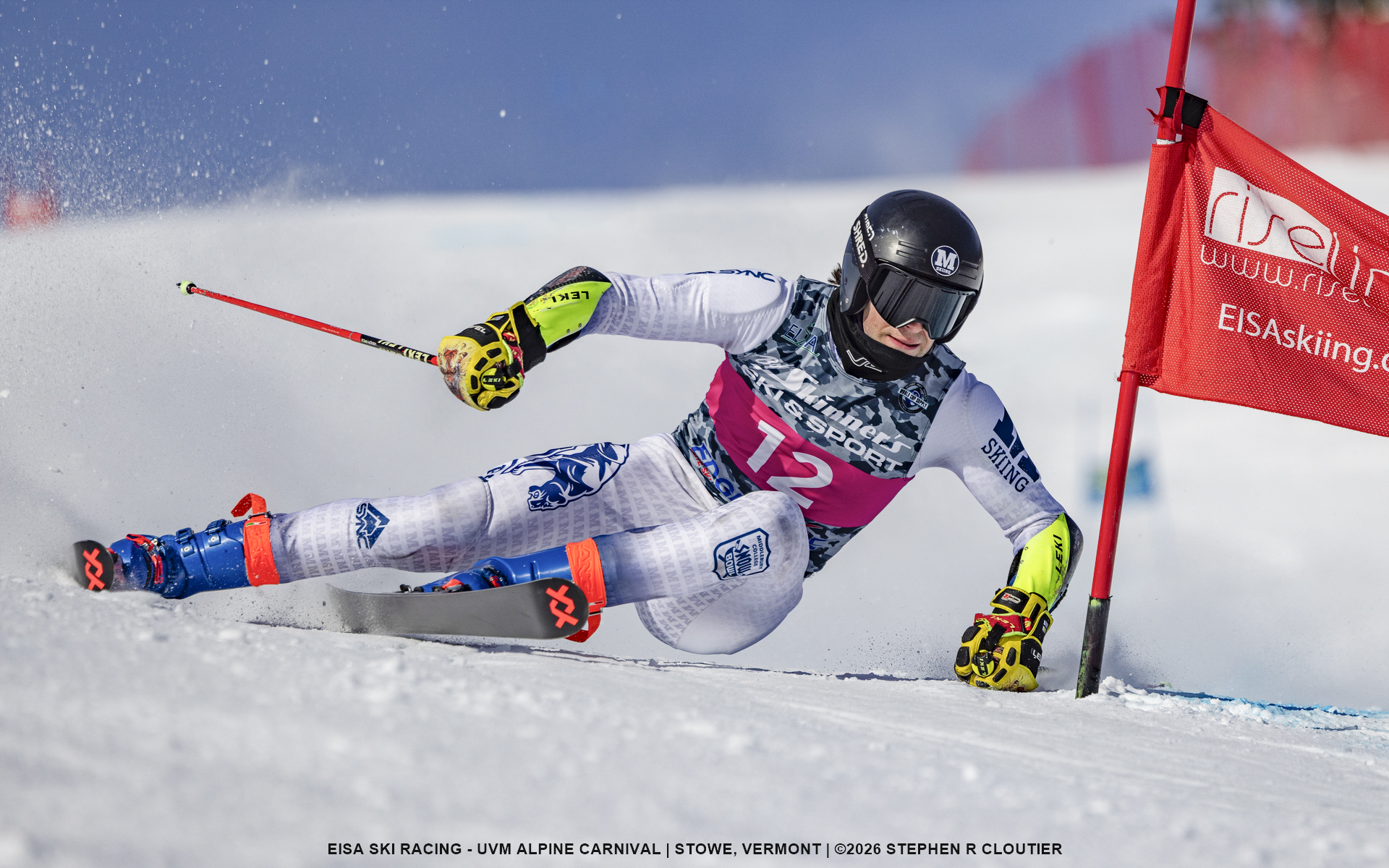
Featured image: Milan Novak (Middlebury College) / Photo: Stephen R. Cloutier
The NCAA has announced the 74 skiers selected for the 2026 NCAA Skiing Championships, and the alpine races are once again expected to play a decisive role in determining the national title.
The championships will take place March 11–14 in Park City, Utah, with the University of Utah serving as host. Alpine competitions are scheduled for March 11 and March 13 at Utah Olympic Park, while nordic races will be contested at Soldier Hollow Nordic Center.
The event was originally scheduled to take place in Bozeman, Montana, hosted by Montana State University, but the NCAA relocated the championships to Park City due to insufficient snow for the nordic competitions.
Athletes qualified through regional championships in the East and West, with selections based on season performance and regional results. The alpine fields feature many international racers and several athletes with strong FIS-level experience, making the competition one of the deepest collegiate alpine championships in recent memory.
The championships will be broadcast live on NCAA.com.
Which eastern women could challenge for the NCAA title?
Programs from the East Region also bring strong alpine representation. Colby, Dartmouth, Middlebury, New Hampshire and Vermont each qualified three women, giving those programs deep lineups capable of scoring significant team points. St. Michael’s College also placed a skier in the championship field. The eastern group includes racers from several nations and programs with long NCAA skiing traditions, adding depth to the women’s alpine competition.
East Region — Women (Alpine)
- 🇮🇹 Benedetta Caloro — University of New Hampshire — 2003
- 🇺🇸 Carissa Cassidy — Colby College — 2002
- 🇺🇸 Carly Elsinger — Dartmouth College — 2003
- 🇨🇦 Kaitlyn Fynn — Middlebury College — 2003
- 🇸🇪 Tilde Kandell — University of New Hampshire — 2001
- 🇳🇴 Isabella Knutsen — St. Michael’s College — 2004
- 🇸🇪 Hedda Martelleur — University of New Hampshire — 2001
- 🇺🇸 Kate McKenney — Colby College — 2006
- 🇺🇸 Kjersti Moritz — Middlebury College — 2004
- 🇺🇸 Althea Noyes — Colby College — 2005
- 🇺🇸 Emma Resnick — Dartmouth College — 2003
- 🇺🇸 Kendahl Roufa — University of Vermont — 2002
- 🇨🇦 Sara Stiel — University of Vermont — 2004
- 🇺🇸Eliza Sullivan- Williams– 2004
- 🇨🇦 Cydnie Timmermann — University of Vermont — 2003
- 🇺🇸 Sophia Tozzi — Middlebury College — 2003
- 🇺🇸 Zoe Zimmermann — Dartmouth College — 2002
Which western women could shape the championship race?
In the West Region, the women’s alpine field is led by several powerhouse programs. Colorado, Utah, Denver and Montana State each qualified three skiers, giving those teams strong scoring potential in the championship races. Nevada and Alaska Anchorage each place two racers in the field, while Westminster University qualified one skier. Together, the western programs bring another internationally experienced group of collegiate racers, setting up a strong battle in the alpine races at Utah Olympic Park.
West Region — Women (Alpine)
- 🇫🇷 Louison Accambray — University of Colorado — 2001
- 🇸🇪 Ella Brome — University of Alaska Anchorage — 2000
- 🇸🇪 Melanie Dahlberg — University of Utah — 2002
- 🇺🇸 Paige DeHart — University of Colorado — 2005
- 🇺🇸 Sophia Falter — University of Nevada — 2007
- 🇳🇴 Guro Hestad Vognild — Westminster University — 2001
- 🇺🇸 Mia Hunt — University of Denver — 2003
- 🇳🇴 Christina Jacobsen — University of Utah — 2004
- 🇺🇸 Tea Kiesel — Montana State University — 2003
- 🇨🇦 Kaila Lafreniere — University of Utah — 2004
- 🇨🇦 Justine Lamontagne — Montana State University — 2002
- 🇳🇴 Cathinka Lunder — University of Colorado — 2003
- 🇺🇸 Erica Lynch — University of Nevada — 2003
- 🇮🇹 Cecilia Pizzinato — University of Denver — 2004
- 🇺🇸 Ainsley Profitt — University of Alaska Anchorage — 2001
- 🇸🇪 Sara Rask — University of Denver — 2000
- 🇨🇦 Lily Sewell — Montana State University — 2004
Which men from the East bring international experience to the championship?
In the East Region, the men’s alpine field features depth at several programs. Dartmouth, Middlebury and Vermont each qualified three skiers, giving those schools strong scoring potential in the championship races. Harvard, Boston College and New Hampshire each placed two racers in the field, while Colby College and St. Lawrence University each qualified one skier, rounding out a deep eastern group that includes several internationally experienced collegiate racers.
East Region — Men (Alpine)
- 🇺🇸 Duncan Armstrong — Harvard University — 2005
- 🇺🇸 Julian Arthur — Middlebury College — 2005
- 🇨🇦 Jayden Buckrell — University of New Hampshire — 2004
- 🇺🇸 Roman Elvidge — University of New Hampshire — 2005
- 🇺🇸 Bode Flanigan — Boston College — 2002
- 🇸🇪 Oskar Gillberg — University of Vermont — 2002
- 🇺🇸 Luke Kearing — Harvard University — 2002
- 🇺🇸 Nick Kirwood — Boston College — 2004
- 🇬🇧 Calum Langmuir — Dartmouth College — 2002
- 🇩🇪 Felix Lindenmayer — University of Vermont — 2002
- 🇺🇸 Townsend Mikell — Colby College — 2004
- 🇺🇸 Alec Nolan — St. Lawrence University — 2002
- 🇨🇦 Milan Novak — Middlebury College — 2005
- 🇨🇦 Heming Sola — Dartmouth College — 2003
- 🇳🇴 Magnus Styren — University of Vermont — 2002
- 🇺🇸 Nick Unkovskoy — Middlebury College — 2002
- 🇳🇴 Oscar Zimmer — Dartmouth College — 2001
Which western programs could dominate the men’s alpine races?
In the West Region, the men’s alpine field is anchored by several traditional NCAA powers. Colorado, Nevada, Utah, Denver and Montana State each qualified three skiers, giving those programs strong depth entering the championships. Westminster University placed two racers in the field as well. Together the western programs bring another internationally experienced group of collegiate racers, setting up a competitive battle in the alpine races at Utah Olympic Park.
West Region — Men (Alpine)
- 🇮🇹 Feb Allasina — University of Colorado — 2004
- 🇦🇹 Benjamin Angerer — Westminster University — 2002
- 🇺🇸 Justin Bigatel — University of Colorado — 2003
- 🇮🇹 Pietro Bisello — University of Nevada — 2004
- 🇨🇭 Gianluca Böhm — Montana State University — 2000
- 🇨🇦 Pierick Charest — University of Utah — 2004
- 🇳🇴 Torjus Hepsoe — Montana State University — 2004
- 🇳🇴 Johs Braathen Herland — University of Utah — 2003
- 🇳🇴 Adrian Minde Hunshammer — University of Denver — 2002
- 🇺🇸 David Morken — University of Nevada — 2005
- 🇮🇹 Pietro Motterlini — University of Denver — 2004
- 🇳🇴 Sindre Myklebust — University of Utah — 2002
- 🇪🇸 Alejandro Puente Tasias — Westminster University — 1994
- 🇧🇷 Christian Soevik — University of Denver — 2001
- 🇨🇦 Will Steed — Montana State University — 2005
- 🇳🇴 Filip Wahlqvist — University of Colorado — 2001
- 🇺🇸 Peyton Wells — University of Nevada — 2005
Could alpine races decide the NCAA championship?
Historically, every discipline and gender determines the NCAA team title, particularly when programs field strong squads in both alpine and Nordic events.
Teams such as Utah, Colorado, Denver, Vermont and Middlebury again appear positioned to contend for the championship.
With internationally experienced racers, deep collegiate rosters and the demanding terrain at Utah Olympic Park, the alpine races in Park City could ultimately determine which school lifts the 2026 NCAA Skiing Championship trophy.
About the Author: SR Staff Report