Editor’s note: This is the second in a two-part story. The first part focuses on U.S. athletes and can be found here.
With the U.S.-Canadian border now open and a full NorAm circuit on the official FIS schedule, teams and skiers from across North America who aspire to get noticed by national team coaches are chomping at the bit to get into a NorAm start gate for the first time in nearly 22 months.
As teams descend upon Copper Mountain for the opening NorAm races, the nervous energy is palatable.
“Athletes don’t know where they’re stacking up, particularly the younger skiers who haven’t had the time at this level yet,” said Johnny Crichton, VP of BC Alpine. “The guys are excited, there’s a bunch of nervous energy which I think is really good.”
Going into the Colorado openers, Crichton said the goal is to treat the races as a valuable learning opportunity. “It’s an interesting mix, when you have veterans using the races to round into form, matched up against young, raw and hungry talent.”
But according to Crichton, predicting the top 10 could be a shot in the dark, or at least a challenge for odds makers.
“Nobody knows how fast anyone is right now,” Crichton said. “We have high expectations but then again, we just don’t know. We’re going to trust our training and avoid putting a result objective on it … but just go in and ski like we know how and deliver on our game plan.”
National team ambitions
For veteran racer Stefanie Fleckenstein, the races can’t come soon enough.
“Everyone is really excited to have the NorAms back, I know I am for sure,” said the 24-year-old skier. “The younger skiers feel kinda cheated the last couple years … when you’re younger the NorAms are a huge deal as it’s basically your way to make the Canadian team.”
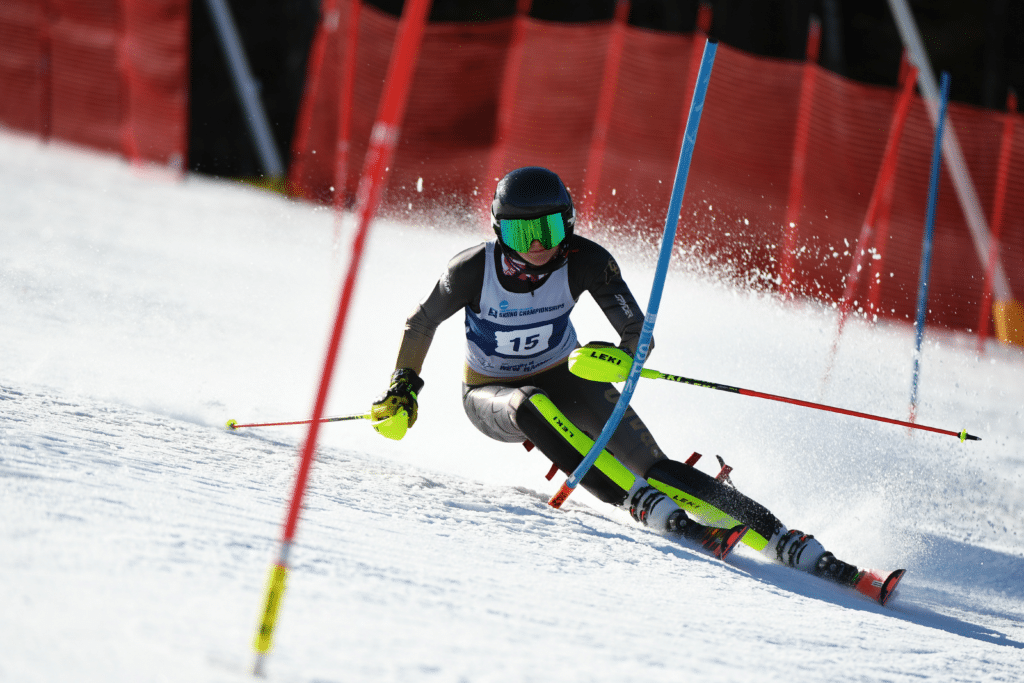
Fleckenstein, 24, is coming off three seasons racing NCAA with University of Colorado and is now with the International Ski Racing Academy program as she pursues Canadian national team criteria. She is using the NorAm openers as a chance to test her training.
“The goal is to perform at those races, I don’t go into any races just for fun, but these are more about scoring,” she said. “I still have big goals for NorAms, it’s going to be a tough race series with lots of high-level athletes.”
NorAm races have played a significant role in Fleckenstein’s development. The former Whistler club skier was surprised to learn she has 56 top-10 finishes in the NorAm circuit (her guess: 15) including an impressive 14 podiums since her first NorAm race in December 2015.
“I’m going to focus more on Europa Cup speed and World Cup speed this season,” she said. “That’s where I need to be performing and where the best opportunities are for me. [Speed events are] something I really enjoy and also where there’s the biggest gap in Canadian racing.”
Cutting her teeth on NorAm and NCAA racing has allowed Fleckenstein a chance to hone her skills.
“Doing tech for those years really helped my speed; it helped me a lot to be honest,” she said. “I’m a better racer now, I’m stronger and more prepared. One hundred percent my speed skiing is better and it’s already shown in training, plus I have a lot more confidence and understand my body more now.”
‘Meat and potatoes’ of the development system
Canadian coaches were ecstatic at the news of the land crossing borders opening for Canadians to enter the U.S. on Nov. 8.
“Really excited that the world is back to a place where we feel safe enough to get back to this level of competition,” Crichton said. “On an excitement factor this is an 11 and operationally and financially it’s also way up there; the fact that we can drive is a major benefit.”
According to Crichton, the NorAms are a vitally important development series.
“It’s the cornerstone of our program,” he said. “It’s the meat and potatoes of development in the pathway to the World Cup.”
Crichton, a veteran coach at the national, provincial and club levels – as well as a well-respected Canadian athletic director – was animated and excited to speak about the purpose of the NorAms.
“We’ve always used the NorAms as our true training ground,” Crichton explained. “It’s where it all happens. You can easily go to Lutsen or Mammoth (traditionally low point-scoring races) and score … and on paper you could present better than what you end up with after NorAms.
“But the reason why guys on the World Cup are where they are is because they didn’t chase fake points. Basically they went to the toughest guy in the playground and stood up and got knocked down, stood up and got knocked down again.
“The point is to get in there, go to war and see what the level is and probably get beat up. And it’s how you react to that beating that defines you. Then you step back, lick your wounds and get back in there again for another round.
“The NorAms are the most challenging environment we have and it’s really tough to get results, especially when you’re a provincial team athlete as there are so many older athletes and college guys that have points; some national team athletes who come back.
“That’s why I love it and even find the NorAms undervalued in our system.”
About the Author: Gordie Bowles