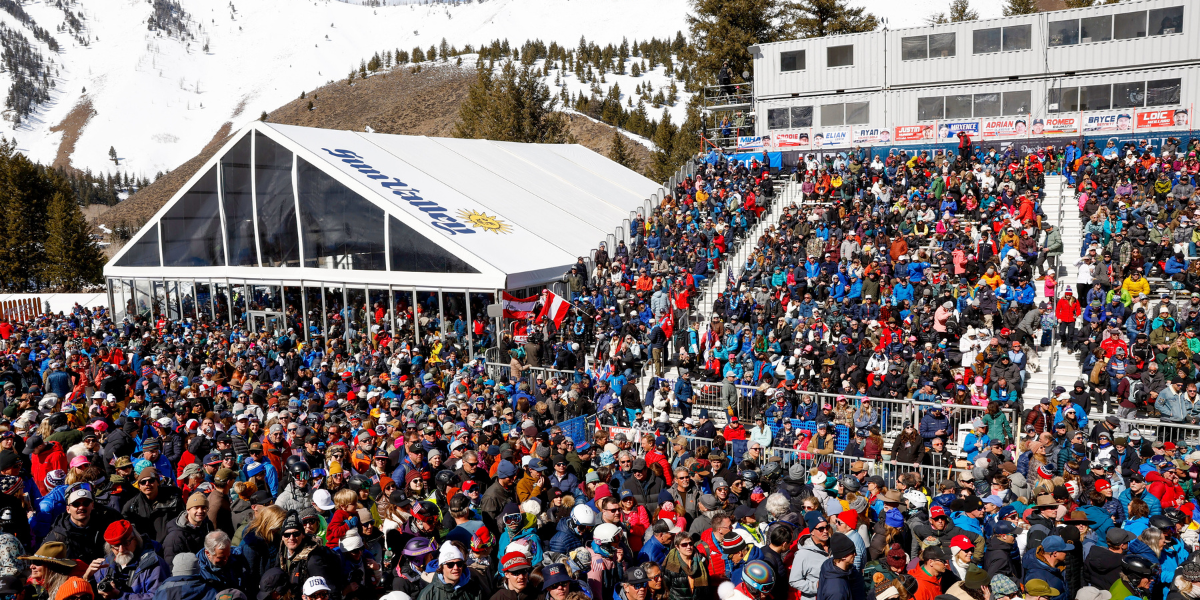
Sun Valley Finish Stadium / GEPA pictures
Proposed Women’s World Cup Calendar: Balance Shifts Across Disciplines
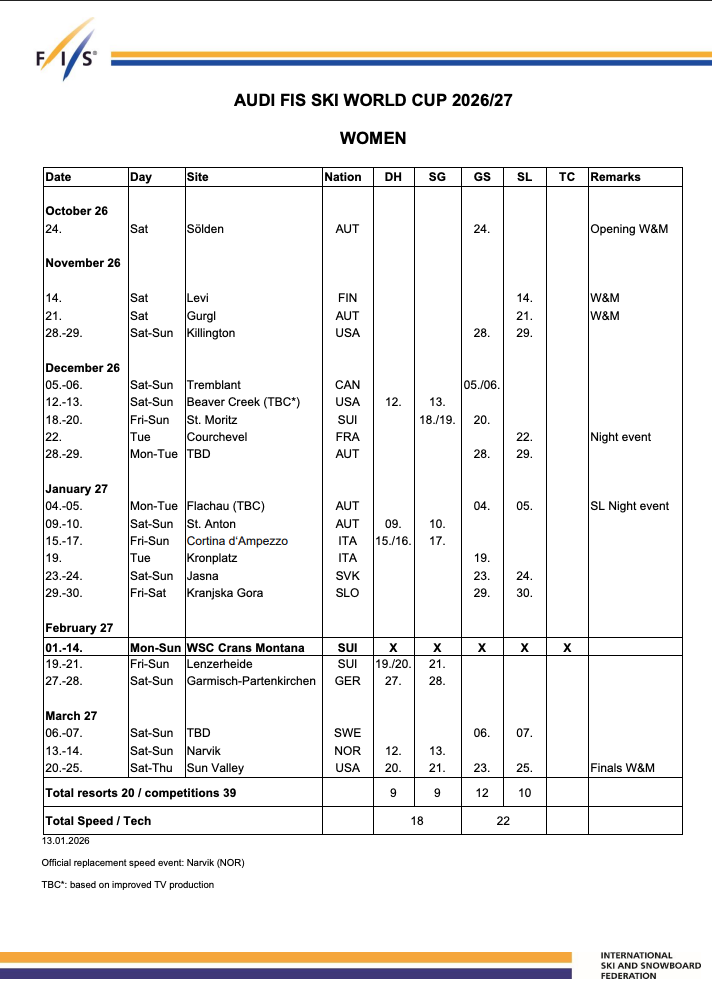
The proposed 2026-27 women’s World Cup calendar does not change the four-discipline structure of the sport, but it does shift the balance within it. Across 39 races, the current draft includes 22 technical events—10 slaloms and 12 giant slaloms—compared to 18 speed races.
That shift is driven by two additional giant slaloms, a 20% increase, along with one more super-G, a 12.5% increase in SG starts. Slalom remains at 10 races, but its relative influence is reduced as other disciplines expand.
The calendar remains provisional, and several venues are listed as TBC (To Be Confirmed), meaning final approval is still pending.
What the Calendar Means for Shiffrin and Aicher
That redistribution of races brings new context to the overall race.
Mikaela Shiffrin remains the most accomplished technical skier in the field. Slalom is still a major factor with 10 races, but it no longer stands on equal footing with giant slalom, which is taking on a larger role in the calendar.
That increases the importance of consistent GS results. Shiffrin is a proven giant slalom winner, but maintaining that level across an expanded schedule will be critical in the overall standings.
Emma Aicher enters from a different position.
The German continues to emerge as a force in speed events while also scoring in the technical disciplines. The increase in GS and SG races directly expands her opportunities, rewarding a more balanced profile across disciplines.
Still, Shiffrin is never an underdog when healthy. Her ability to win races and control momentum keeps her firmly in contention regardless of structure.
North American Races: Killington, Tremblant, Beaver Creek and Sun Valley
The proposed calendar places a strong spotlight on North America, with multiple race opportunities across the United States and Canada.
The early-season block begins with Killington, where giant slalom and slalom offer immediate chances to build points. The tour then moves to Tremblant in Canada, adding a multiple giant slalom stop and extending early momentum opportunities.
The schedule later shifts to Beaver Creek (TBC), where speed races are planned. If confirmed, it would provide an important test in downhill and super-G before the calendar returns to Europe.
Late-Season Return for Sun Valley Finals
The season concludes with the World Cup Finals in Sun Valley, requiring a second trip to North America late in the season.
By that stage, the distribution of races becomes decisive. Skiers who have taken advantage of expanded opportunities in giant slalom and super-G may arrive with stronger positioning, while others will need to maximize every remaining start.
Why the Proposed Calendar Tightens the Overall Race
If the calendar holds, it does not favor one discipline outright—it redistributes influence across the season.
Slalom remains a key part of the calendar, but the expansion of giant slalom and super-G increases the value of versatility and consistent scoring.
The result is a more competitive structure—one shaped by sustained performance across all four disciplines, rather than reliance on a single strength.
Proposed Women’s Calendar
Click on the calendar to download
Proposed Men’s World Cup Calendar: Balance Shifts, Pressure Builds
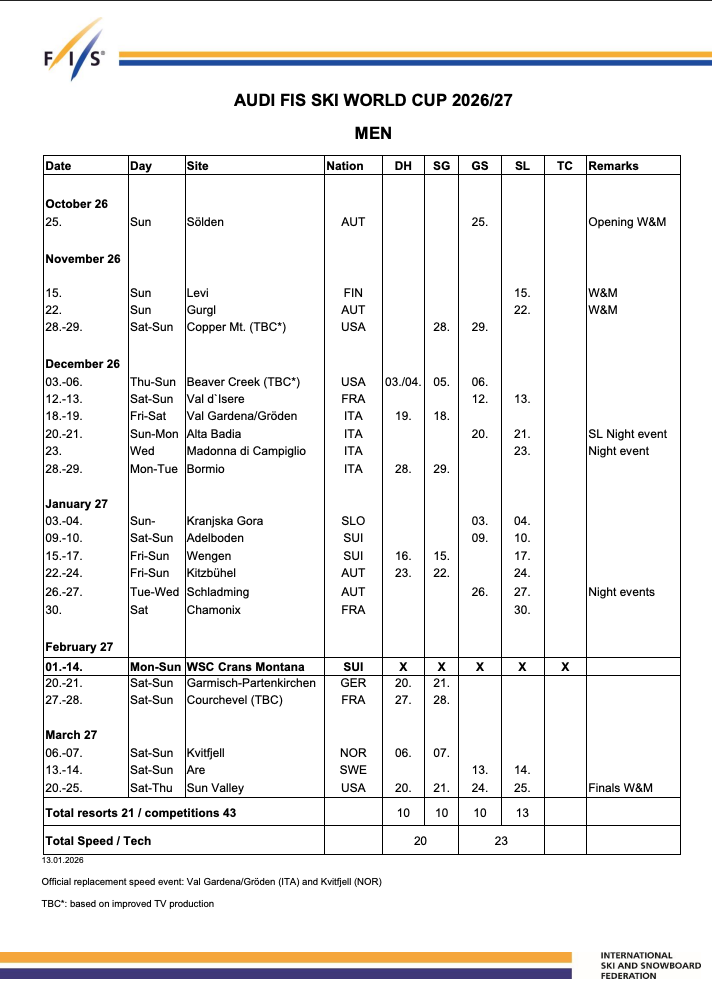
The proposed 2026-27 men’s World Cup calendar introduces a subtle shift that could influence the overall race. With more technical races than speed events, the structure creates additional scoring opportunities for slalom and giant slalom specialists while placing greater weight on each speed result.
That balance does not redefine the sport, but over the course of a full season, it changes how points are built—and how leads are protected.
How the Calendar Impacts Marco Odermatt
That shift matters for Marco Odermatt.
The Swiss star continues to dominate in giant slalom, super-G and downhill, but the current balance means his closest challengers who ski slalom will have more chances to accumulate points across the season. It is not a direct disadvantage, but it reduces the margin that has separated him from the field in recent years.
More slalom races create more opportunities to respond, recover and stay in the standings. For Odermatt, that increases the pressure on every start, particularly in a schedule with fewer speed races to build separation.
U.S. Races: Copper Mountain, Beaver Creek and Sun Valley
The proposed calendar also places a strong spotlight on the United States, with up to six men’s races scheduled across three key stops.
The North American stretch begins with Copper Mountain, listed as TBC, in a key early-season position. If confirmed, it would add another technical opportunity before the calendar fully transitions into its traditional rhythm.
The focus then shifts to Beaver Creek, where downhill and super-G anchor the early speed season. With fewer speed races overall, results there carry increased importance. Strong performances are essential to match the points being built through the technical schedule.
Late-Season Return to the U.S. for Sun Valley Finals
The season concludes with the World Cup Finals in Sun Valley, requiring a second trip to the United States late in the season.
That timing adds another layer to the calendar. Athletes must manage travel, recovery and form before the final races that decide the standings. By this stage, those who have capitalized on the higher volume of technical races may arrive with an advantage, while speed-focused contenders will need to convert every remaining opportunity.
Why the Proposed Calendar Tightens the Overall Race
The calendar remains provisional, and changes are still possible. In its current form, however, it creates a more compressed and competitive structure.
Fewer speed races increase the consequence of each result. More technical races extend opportunities for rivals to score consistently. Together, that combination tightens the overall race, shifting it away from runaway dominance and toward sustained pressure across the season.
Proposed Men’s Calendar
Click on the calendar to download
About the Author: Peter Lange