Getting Ready for Fall Camp
Hi! My name is Abishai Corey, and I am 19 years old. I am starting my first year on the NCAA circuit skiing for the University of New Hampshire. It’s the time of year when skis come out of storage and get packed for the first training camp of the season. This year, I am traveling to Nakiska, Canada, with UNH for our 10-day fall camp.
The first few days of returning to snow are crucial for rebuilding a foundation after a summer hiatus from skiing. The tuning equipment you pack matters just as much, especially when traveling to unfamiliar snow and weather conditions. Since this is my first time visiting Nakiska, I want to understand the weather and the tuning equipment I’ll need. Ski racers know that bag weight is always a brutal price to pay, so read below for the essential tuning items you’ll want for an away fall camp.
Packing Skis for Air Travel
To start, I’d like to discuss how I pack my skis to keep them safe when I travel on airplanes. My goal is always to keep my ski bag under 50 pounds. For a short pre-season camp, I bring one pair of GS skis and one pair of SL skis. You can bring a second ski bag, but the airline’s round-trip fees are expensive. Before packing, I check the weather at my destination, and most mountains have cameras and weather-prediction tools that give a realistic sense of temperatures.
Nakiska appears to be averaging lows of 15–25 degrees Fahrenheit and highs from 35–45 degrees. We train from 7:30–11:30 a.m., when the snow is usually much colder than the air. Snow reaches its coldest point around 6–7 a.m., after a long stretch without sun. The surface begins to warm once daylight returns, but the air warms faster than the snow. Because of this difference, I plan to mix my red (25°–10°F) and blue (14° to –22°F) performance waxes to match the expected snow temperatures. For precise readings, I use TOKO’s snow thermometer.
Why Apply a Travel Layer of Wax
Waxing your skis before packing them is optional, but it gives two major benefits. The first benefit comes from applying wax that matches the expected temperatures. A fresh layer hydrates your bases for several days, and your skis arrive ready for the conditions you will ski on. If the wax isn’t matched to the snow, your skis can drag instead of glide.
The second benefit is protection. A travel layer shields your bases during transport. Airport security often opens ski bags and rearranges their contents. Even if you pack carefully, poles or clothing zippers can shift and scrape your bases. A protective wax layer helps guard against scratches and reduces the chance of damaging your skis.
Tools to Travel with
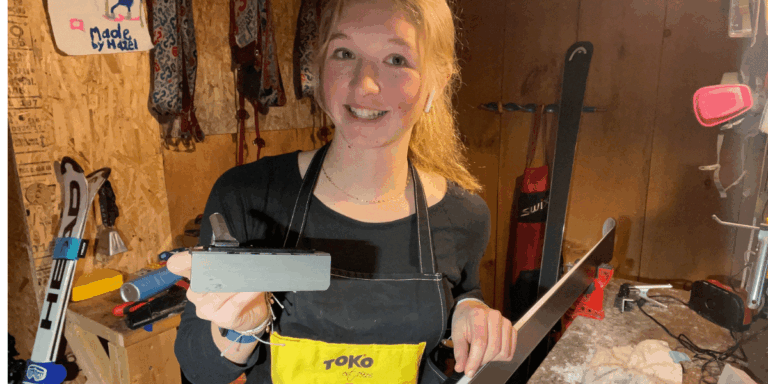
As for tuning gear, you only need a few pieces to be fully set for your trip. Always communicate with your team and coach before traveling to avoid unnecessary duplicate items. Most of the time, a coach will provide a tuning bench, vices, and irons. If these items are provided, you should bring one block each of blue, red, and yellow wax; a coarse (200), medium (400), fine (600), and extra-fine (1000) diamond stone; one 200mm chrome file; two 3-degree (#87) side-angle guides; two side-angle clamps; 2–4 rubber bands; two plexi scrapers; one copper brush; and one horsehair brush.
You rarely finish an entire block of wax at a two-week camp. One block of a single color usually lasts two to three weeks. I bring all three colors so I can react to any unexpected temperature swing, whether the day reaches 45 degrees or drops to 5 degrees. If your coaches do not bring irons or vices, you’ll need to pack your own.
Packing a Smart Ski Bag
These tuning items cover a 10–12-day camp. For longer trips, I bring an extra block of wax and a few more rubber bands. All my tuning gear fits inside my TOKO wax box, which travels well.
After waxing my skis, I pack my TOKO box and then place both skis in my long, rolling ski bag. Here’s a helpful tip: lay the skis in opposite directions—tip to tail, then tail to tip. The bindings nest together, increasing stability. I place my TOKO box at the bottom of the bag and zip it up. With skis, poles, tuning gear, and a jacket or two, the bag usually lands right at 50 pounds, which keeps me from paying a $200 overweight fee.
Ready for Camp
With the right wax, the right tools, and a smart packing plan, you arrive ready to train instead of scramble for tuning gear. Now you’re ready to travel, tune, and hit the snow for your fall pre-season camp.
About the Author: Abishai Corey