
This article is part of the Rowmark Science Corner, a continuing series that explores evidence-based training principles, performance science, and long-term athlete development in alpine ski racing.
INTRODUCTION
VO₂ priming is an advanced warm-up strategy that can enhance performance in elite alpine skiers by accelerating oxygen uptake at the onset of high-intensity activity. Alpine skiing demands short, maximal efforts that benefit from a carefully structured priming routine. In addition to raising muscle temperature, these routines improve cellular responsiveness to oxygen transport and utilization. This increased efficiency can extend work capacity during intense runs.
Coaches, athletes, and practitioners have long recognized the benefits of priming through experience, but recent technology has allowed more precise investigation of these effects. In particular, near-infrared spectroscopy (NIRS) has emerged as a powerful tool to monitor and analyze VO₂ priming. Unlike traditional systemic measures such as heart rate or whole-body VO₂, NIRS provides real-time, muscle-specific data on oxygen saturation and hemodynamics, allowing a more individualized and targeted approach to warm-up protocols.
One key phenomenon observable through NIRS is oxygen overshoot — a temporary rise in muscle oxygen saturation above pre-exercise baseline levels during recovery from high-intensity exercise. This overshoot, of particular interest to alpine skiers, reflects the body’s compensatory mechanisms aimed at restoring homeostasis and may signal an effective priming response. Understanding and harnessing this response could play a pivotal role in optimizing performance for alpine skiers.
Combating Fatigue in Alpine Skiing
How to combat fatigue or mitigate the premature onset of fatigue has long intrigued the alpine scientific community. Leading sport scientists and practitioners — including Bob Poehling, Sue Robson, and Andy Walshe — have long advocated the performance benefits of incorporating aerobic efforts and shorter bursts of anaerobic work before athletes leave the start gate. Among other recommendations, they have suggested that an athlete should spend two to three minutes above lactate-threshold heart rate within 20 minutes of kicking out of the start gate.
Recent investigative work, supported by new technologies such as near-infrared spectroscopy (NIRS), has reinforced these practices. NIRS allows researchers to observe how the body increases oxygen levels in the muscles immediately after a high-intensity effort.
NIRS Response and Oxygen Overshoot
A normal NIRS response to exercise shows a drop in muscle oxygen saturation (SmO₂) as the muscle extracts oxygen faster than it is delivered. Following a high-intensity bout, NIRS captures a distinct recovery pattern:
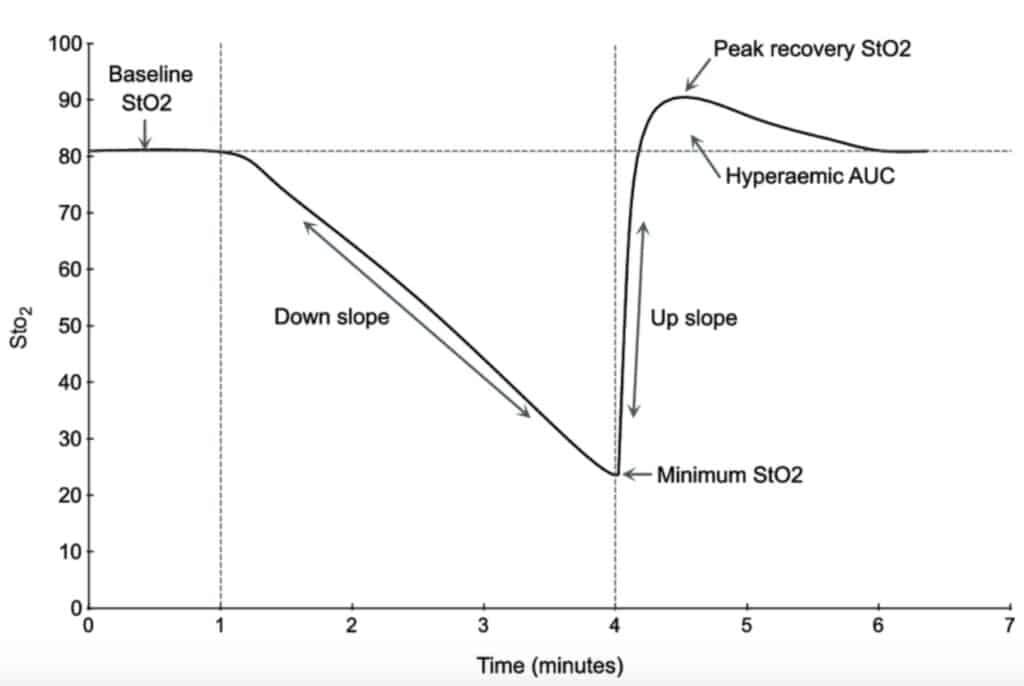
- Initial rapid recovery: Immediately after exercise, SmO₂ rises quickly as oxygen consumption drops but blood flow remains elevated from vasodilation.
- Reactive hyperemia: SmO₂ and total hemoglobin levels often rise above resting values — a post-exercise phase caused by a surge in blood flow that repays the “oxygen debt” incurred by working muscles.
- Return to baseline: Over several minutes, oxygen delivery and consumption normalize, and NIRS signals return to pre-exercise levels. When this process is repeated, oxygen kinetics become increasingly sensitive, improving efficiency during subsequent bouts.
Enhanced Oxygen Utilization
During an intense burst, the body deoxygenates the muscles but then not only restores oxygen balance to pre-burst levels — it overshoots, raising oxygen saturation above the starting baseline during recovery. This overshooteffect allows the body to supply oxygen for the next maximal effort.
This chart illustrates SmO₂ trends in the vastus lateralis muscle of an elite alpine skier during a training protocol. The green line represents SmO₂ levels throughout warm-up, a 90-second high-intensity interval on a stationary ergometer, and the recovery phase.
Key observations:
- Baseline: During warm-up, SmO₂ remains stable, showing balanced oxygen supply and demand.
- High-intensity phase: SmO₂ drops sharply as muscles rapidly consume oxygen.
- Post-interval overshoot: After the effort ends, SmO₂ rises above baseline — the hallmark of reactive hyperemia and improved oxygen delivery during recovery.
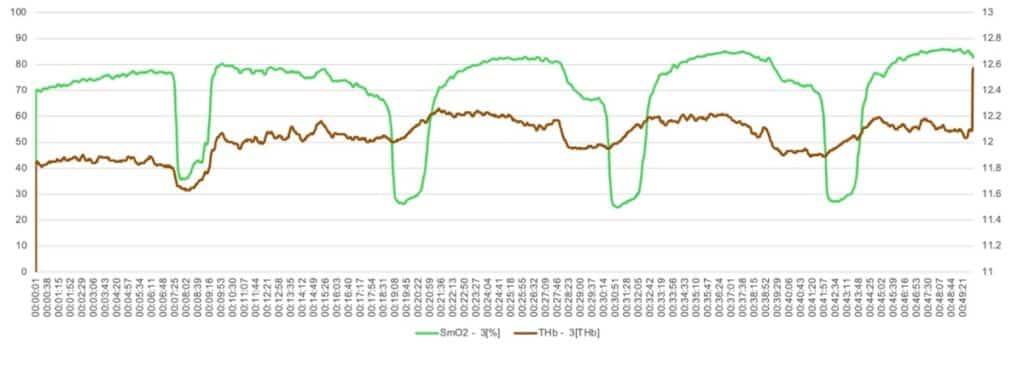
This pattern reflects a trained athlete’s efficiency in both oxygen extraction and recovery — qualities essential for high-intensity, intermittent sports like alpine skiing.
Application in Elite Ski Racing
For athletes and coaches, oxygen overshoot can extend maximal work capacity during a race run and delay the onset of fatigue. Elite racers, such as Erik Arvidsson, have applied these insights by experimenting with short, high-intensity bursts during pre-start warm-ups. These efforts help optimize both physical readiness and mental focus at the start gate.
As the scientific understanding of oxygen kinetics deepens, evidence shows that high-intensity bursts can enhance the muscles’ ability to utilize oxygen efficiently. These practices — increasingly known as VO₂ priming strategies — are now recognized across high-performance sport science as effective tools to mitigate premature fatigue in alpine ski racing.
Benefits for Race Performance
VO₂ priming techniques prepare an athlete’s body for the specific, high-intensity demands of a race run. A typical World Cup run lasts less than 90 seconds, demanding all-out effort from both aerobic and anaerobic systems.
Research and field data show positive trends among elite skiers who use strategies to upregulate blood flow and boost oxygen delivery before starting. These approaches improve sustained work capacity and help athletes endure the longer, fatiguing courses they encounter throughout their development and competitive careers.
Exploring VO₂ Priming
VO₂ max, often referred to as aerobic capacity, is the maximum amount of oxygen the body can use during intense or near-maximal exercise. It’s a key indicator of cardiovascular fitness and endurance, measuring how efficiently the body transports and uses oxygen to produce energy during physical activity.
VO₂ priming refers to a short, high-intensity bout of exercise performed before a main workout or competition to improve later performance. It works by speeding up oxygen uptake kinetics, allowing the body to access and use oxygen more efficiently during subsequent, more demanding efforts. This can lead to improved endurance and greater work capacity above the critical power threshold — to use cycling terminology.
VO₂ priming is a stage where a prior bout of exercise accelerates oxygen uptake (VO₂) kinetics in subsequent efforts. Studies show that it can enhance endurance by improving the body’s ability to use oxygen efficiently during repeated or sustained exercise.
Motor Unit Recruitment and Oxygen Utilization
The effects of priming appear to stem partly from altered motor-unit recruitment patterns. Priming exercise seems to increase motor-unit recruitment early in the activity, allowing more fibers to engage sooner and reducing the need for additional recruitment as exercise progresses.
This altered pattern may lead to an increased fundamental VO₂ amplitude and a reduced VO₂ slow-component amplitude. Research also supports that VO₂ priming enhances intracellular oxygen utilization.
Single-muscle-fiber studies indicate that priming may accelerate intracellular oxygen-use kinetics even without changes in baseline oxygen partial pressure (PO₂). This suggests faster adjustments within the cellular machinery responsible for oxygen uptake and use.
Mitochondrial and Metabolic Mechanisms
Other proposed mechanisms include:
- Increased activity of enzymes involved in mitochondrial oxidative phosphorylation, such as pyruvate dehydrogenase.
- Elevated mitochondrial calcium levels, which modulate enzyme activity.
- Parallel activation of ATP-consuming and ATP-producing processes at the onset of exercise.
Priming exercise enhances both convective (blood flow) and diffusive (oxygen transfer) oxygen delivery to the muscles. Evidence includes increases in heart rate, cardiac output, muscle blood flow, and indices of microvascular oxygenation — such as total heme and muscle O₂ saturation — following priming.
The rise in total heme after priming has been correlated with a smaller VO₂ slow-component amplitude, meaning the body transitions to efficient oxygen use more quickly.
Complex Interplay of Adaptations
That said, while priming often improves muscle oxygen delivery, it may not always be the primary cause of performance gains. The VO₂-priming effect likely results from a complex interplay of physiological adaptations centered around enhanced intracellular oxygen use, altered motor-unit recruitment, and improved oxygen delivery.
More research is needed to fully understand these mechanisms and to optimize priming strategies for different individuals and exercise contexts, including how they interact with the muscular demands of alpine skiing.
Skiing involves rapid transitions between concentric, eccentric, and quasi-isometric contractions, all occurring at high rates to keep the ski edge clean and engaged against snow and ice.
Practical Application: How VO₂ Priming Works
As discussed in the introduction, VO₂ priming is a strategy to optimize aerobic efficiency. It involves a short, high-intensity effort before the main training or race session, designed to accelerate the VO₂ response during subsequent activity.
In alpine skiing, where coaches and athletes seek ways to delay fatigue to improve performance and reduce injury risk, priming can extend time to exhaustion for efforts above functional threshold power (FTP).
Outside skiing, structured sports such as cycling provide strong evidence that VO₂ priming improves performance without altering critical power (FTP). In these studies, athletes achieved longer time to exhaustion at fixed workloads — for example, sustaining 500 watts longer — despite no change in FTP.
Mechanisms and Recovery Balance
The mechanisms behind VO₂ priming remain under investigation, but it’s widely accepted that the effect stems from changes in VO₂ kinetics and increases in VO₂ max. In simple terms, priming helps the body achieve higher oxygen-use rates more quickly.
When priming is followed by adequate recovery, these benefits can occur without significant fatigue, allowing athletes to maintain quality in subsequent intervals.
Implementing VO₂ Priming Techniques in Alpine Skiing
Given all the reported benefits of VO₂ priming, how can it be implemented in training and preparation for optimal performance in alpine ski racing?
Scientists in the alpine community are quick to point out that VO₂ priming supports performance during work above the lactate threshold — which is where alpine skiing primarily occurs. Priming is believed to be most effective before high-intensity sessions, such as race runs, and less necessary for low-intensity endurance sessions, since those efforts are not limited by VO₂ max.
Research shows that just six minutes of heavy exercise — roughly at the “sweet spot” of intensity — followed by about 10 minutes of recovery can be effective for VO₂ priming. In alpine skiing, athletes often perform shorter, segmented bursts or intervals, since the environment near the start house usually isn’t suitable for longer periods of high-intensity effort.
Coaches and high-level elite skiers encourage younger athletes to experiment and find what works best for them — both physiologically and mentally. Many elite athletes report that adding a few short (about 30-second) intervals at or above lactate threshold, interspersed with two- to three-minute threshold efforts, helps them feel more prepared for a hard ski run or an interval session.
Below is an example of a priming workout that features an extended warm-up with short bursts designed to prepare athletes before they kick out of the start gate.
Sample VO₂ Priming Protocol for Alpine Skiing
A priming protocol for alpine skiing must balance short, intense effort with enough recovery time to prevent fatigue before the race starts.
Timing: The warm-up should conclude 10–15 minutes before the start of the run.
This protocol assumes an ideal training or race-day environment — a good warm-up location, efficient lift access, and sufficient time to reach the start.
1. General Warm-Up (10–15 Minutes)
- Perform light aerobic activity, such as jogging, stationary cycling, light-resistance rowing, or other aerobic exercises.
- Gradually increase intensity to elevate muscle temperature without causing fatigue.
2. Dynamic Stretching and Muscle Activation (5–10 Minutes)
- Focus on ski-specific movements — squats, lunges, and leg swings — to activate the core and prepare key skiing muscles.
- Include upper-body movements and pole plants to simulate the poling motion used when exiting the start gate.
3. High-Intensity Priming Effort (4–8 Minutes, in Segments or Intervals)
- Perform one or more heavy-intensity efforts that significantly elevate heart rate.
- Examples include cycling or running at 85–95 percent of maximum heart rate, or performing high-resistance, ski-specific movements such as uphill running in boots or ski-pole sprints.
- Some athletes add box jumps or short sprints to simulate the explosive power needed at the start.
4. Recovery Period (15–45 Minutes)
- Engage in very light movement, such as walking or gentle pedaling, to maintain active recovery while the heart rate decreases.
- This is the critical “priming window,” when physiological benefits are secured without creating pre-race fatigue.
5. Pre-Start Activation
- A few minutes before entering the start gate, perform quick, powerful movements such as a few box jumps or strong leg swings to re-activate the central nervous system.
- These last explosive actions help ensure the athlete feels awake, dynamic, and ready to attack the course from the first gate.
Conclusion
VO₂ priming offers a highly effective strategy for optimizing alpine athletes’ performance, particularly when applied immediately before race runs. Engaging in targeted, high-intensity exercise prior to competition can acutely enhance VO₂ max, accelerate oxygen uptake kinetics, and increase cellular sensitivity to oxygen — all key factors that translate into improved aerobic efficiency and delayed fatigue during demanding race efforts.
For coaches and sport scientists in alpine disciplines, implementing VO₂ priming as a pre-race intervention can give athletes a measurable physiological edge. By strategically integrating VO₂ priming into warm-up routines, athletes may achieve faster oxygen delivery and utilization, resulting in sharper performance during the repeated, high-intensity efforts characteristic of alpine racing.
Overall, VO₂ priming represents a practical, evidence-based approach to elevate competitive outcomes and should be considered a key component of race-day preparation for alpine athletes.
As the science of VO₂ priming continues to evolve, its practical applications are becoming increasingly clear. Most alpine athletes stand to benefit from rethinking and intensifying their pre-race warm-up routines. A more deliberate, data-informed priming strategy could unlock significant gains in both performance and fatigue resistance.
Want a simpler explanation?
If you’d like to explore the same ideas in a more straightforward format, click the link below. It provides an athlete-friendly version of this article—perfect for developing racers, parents, and coaches who want to better understand VO₂ priming. The version remains true to the insights of Per Lundstam, Bob Poehling, Sue Robson, and Andy Walshe, reflecting their shared expertise in performance and ski racing science.
Explore more evidence-based insights on strength training, performance development, and applied sport science in alpine skiing in the Rowmark Science Corner series.
About the Author: Per Lundstam