
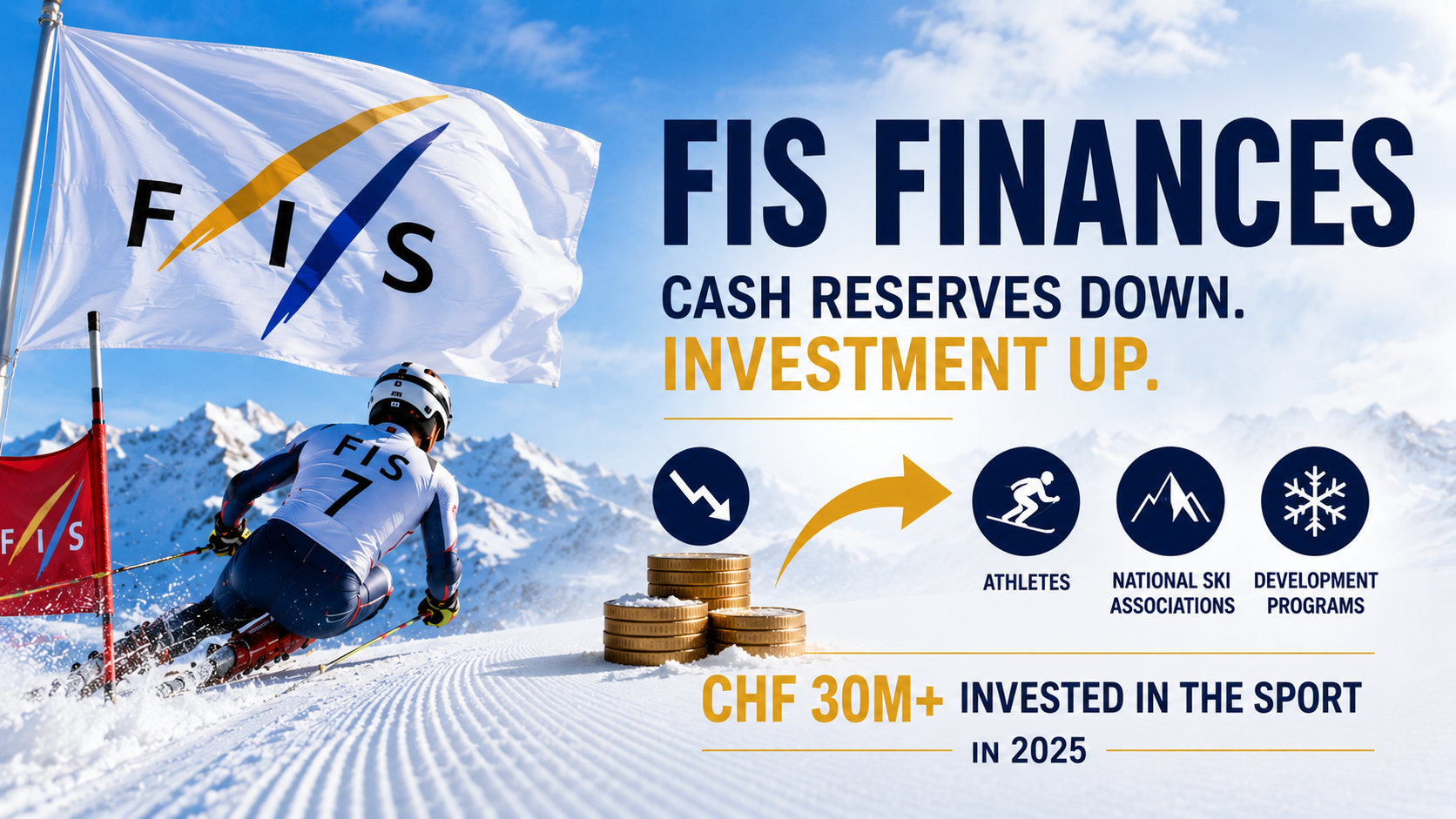
Is FIS running out of money?
That question has circulated through parts of the international ski community as critics point to a sharp decline in the federation’s cash reserves. Yet a review of five years of financial documents tells a more nuanced story.
The International Ski and Snowboard Federation has less cash and securities on hand than it did several years ago. That much is true. However, the audited statements also show a federation with substantial assets, positive equity, clean audit opinions and a deliberate strategy of directing more money into national ski associations, athlete support, prize money and development programs.
The central question is not whether FIS is about to close its doors. Nothing in the audited statements or auditor reports suggests that.
The real question is different: How much money should an international winter sports federation keep in reserve, and how much should it put back into the sport?
That is the debate the numbers actually support.
Why are people concerned about FIS finances?
The concern begins with one visible number: cash and securities.
FIS financial summaries show that cash and securities have declined in recent years. On a standalone basis, FIS cash and securities fell from CHF 145.6 million at the end of 2022 to CHF 65.9 million at the end of 2025. When the Marc Hodler Foundation is included, the combined figure fell from CHF 145.9 million to CHF 92.2 million over the same period.
Those numbers deserve attention. Any major reduction in reserves should be examined carefully, especially in a sport facing rising event costs, climate pressure, changing media markets and increasing financial demands on national federations.
Critics can fairly argue that lower reserves reduce flexibility and leave FIS more exposed to future economic downturns or unexpected disruptions to the winter sports calendar.
However, cash balance alone does not tell the full story.
FIS is not a private company built to maximize retained earnings. It is a Swiss association that exists to govern, promote and develop skiing and snowboarding. In that context, money held in accounts is only one measure of financial strength. Another is how much of that money reaches the sport.
What do the numbers show?
The audited statements and financial summaries show several key points:
- FIS distributed CHF 20.6 million to national ski associations in 2021.
- Total distributions and contributions increased to CHF 29.3 million in 2025.
- The 2025 audited statements show more than CHF 30.2 million in total contributions to national ski associations and sport-support programs.
- FIS reported CHF 43.0 million in standalone equity at the end of 2025.
- The consolidated FIS group reported CHF 68.7 million in equity at the end of 2025.
- Independent auditors issued unqualified opinions and did not report fraud, significant audit differences or relevant legal breaches.
Those figures tell two stories at once. Cash reserves have declined, but distributions and contributions to national ski associations have increased. Any assessment of FIS’ financial health should consider both trends.
Where did the money go?
A significant portion of the decline in reserves came from deliberate distributions and support payments.
In 2025, FIS reported total contributions of more than CHF 30.2 million. That included CHF 5 million in normal distributions, CHF 7.5 million in special distributions, CHF 9.3 million connected to Infront distributions, CHF 230,897 in other financial support and CHF 8.2 million categorized in the accounts as “Prize Money, Telemark & Development Support.”
For readers outside federation finance, the broader point is simpler: much of the money moved from FIS accounts into the sport.
That matters.
Every year, national federations rely on international support to help fund athletes, travel, coaching, development programs, event operations and competitive pathways. For smaller ski nations, federation support can help determine whether athletes can access international competition at all.
That is the context behind the spending strategy. Money held in a reserve account may strengthen a balance sheet. Money distributed to national federations, prize money and development support can strengthen the sport itself.
The question is how to balance those two priorities.
What did the auditors say?
Independent auditors have not raised the kind of concerns that would support claims of financial instability.
Ernst & Young issued an unqualified opinion on the 2025 FIS financial statements. The auditor said the statements complied with Swiss law and the association’s articles of incorporation and recommended that the financial statements be approved.
EY’s comprehensive report went further. It reported no relevant breaches of law, articles of incorporation or organizational regulations. It found no significant audit differences. It confirmed the existence of an internal control system. It also said that, as part of the audit, it did not identify fraudulent acts or indications of fraud.
Those findings matter.
They do not settle every policy disagreement. They do not mean every stakeholder must support FIS’ Council-approved spending strategy. They do, however, provide important context when evaluating claims about the federation’s financial health.
Is FIS solvent?
The audited statements show that FIS remains solvent.
At the end of 2025, the standalone FIS balance sheet showed CHF 86.3 million in total assets and CHF 43.0 million in total equity. The consolidated balance sheet, which includes subsidiaries, showed CHF 117.4 million in total assets and CHF 68.7 million in total equity.
Those figures are lower than the previous year. Still, they show a federation with substantial assets and positive equity.
The 2025 standalone statement reported a loss of CHF 16.7 million, while the consolidated statement reported a loss of CHF 16.5 million. However, both statements show a positive result before contributions and support payments to national ski associations and other sport-support programs totaling more than CHF 30 million were recognized.
That distinction is essential.
On a consolidated basis, FIS reported CHF 4.7 million in net result before contributions to national ski associations in 2025.
In plain terms, FIS did not post a loss because its core operation failed to produce revenue. It posted a loss after choosing to distribute substantial resources back into the sport.
Why were reserves so large?
FIS built substantial reserves over many years.
That gave the federation financial security. It also created the policy question now at the center of the debate.
Should a winter sports federation preserve large reserves for long-term protection? Or should it deploy more of those reserves to support national federations, athletes and events during a period when the cost of competing and staging races continues to rise?
There is no simple answer.
A conservative reserve policy can protect the organization from shocks. An aggressive reinvestment policy can provide immediate help to the people and programs that make the sport function.
The audited documents show that FIS has moved toward the second approach.
What changed under the current leadership?
The current FIS leadership has taken a different approach from the previous era.
The philosophy is straightforward: money sitting in accounts does not, by itself, develop the sport. Athletes, events, national ski associations and development programs do.
Supporters of FIS President Johan Eliasch’s approach also note that he does not draw a FIS salary and covers his own expenses. They argue that the current administration has focused on directing more federation resources toward the sport rather than preserving larger reserves.
That point is relevant, but it should not overshadow the audited numbers.
The stronger and more document-supported conclusion is that FIS has made an intentional financial choice. It has chosen to return more resources to skiing and snowboarding.
Some stakeholders will prefer a more conservative reserve policy. Others will support a more aggressive reinvestment model.
Both views deserve to be heard.
What is the real debate?
The real debate is not whether FIS is insolvent. The audited financial statements do not support that claim.
The real debate is how much money FIS should keep in reserve and how much it should distribute.
Critics can fairly argue that lower cash balances reduce flexibility. Supporters can fairly respond that an international federation should not treat large reserves as the end goal while national federations, athletes and events need support.
The strongest reading of the financial statements sits between those positions.
FIS has less cash on hand than it did several years ago. That is true.
FIS has also distributed significantly more money to national ski associations, prize money, athlete support and development. That is also true.
Independent auditors have issued clean opinions and did not report fraud, significant audit differences or relevant legal breaches. That is a third key fact.
Together, those points show a federation making an intentional financial choice, not an organization on the edge of collapse.
The bottom line
FIS’ financial position deserves scrutiny. Any organization responsible for global winter sport should expect that.
However, scrutiny should start with the full record.
The audited statements do not show a federation on the brink of collapse. They show a federation with declining reserves, positive equity, substantial assets and major distributions back into skiing and snowboarding.
Whether that strategy proves wise over the long term will be judged in the years ahead.
What the numbers already make clear is that the debate is about priorities, not survival. The audited statements show a federation choosing to invest more of its resources in skiing and snowboarding, while remaining financially solvent.
About the Author: Peter Lange