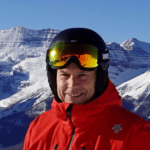

Ken Read, 1975 La Compression d’Isère Downhill: Photo courtesy Ken Read
A Morning That Felt Different
December 7, 1975 – Val d’Isère, France. Critérium de la Première Neige, opening downhill of an Olympic winter.
That crisp, clear December morning on the upper slopes of La Daille is etched in my memory. It felt different. The warm-up turns in my pre-race preparation linked effortlessly, and the entire routine had a comfortable clarity.
An Intimidating Venue
In our era, Val d’Isère was intimidating. This was the Critérium de la Première Neige on the “Oreiller-Killy” track, honoring two great French ski racers—the first downhill of the season, the traditional opener. Two days earlier, Olympic silver medalist and two-time World Cup downhill champion Roland Collombin had crashed in training, ending his career. French skier Michel Dujon had tragically died in a ski testing accident. Tension was high.
My usual routine—starting slowly and amping up the speed with each training run—was behind me. But this wasn’t just any race day. After a rookie year starting from bibs in the 40s and 50s, I was now in the first seed—the top 15.
A few weeks earlier, I’d joked with our head coach, Scott Henderson: “What if I draw bib No. 1?” The night before the race, he walked into our room (I was bunking with Dave Irwin), tossed the bibs over and said with a grin: “You got the number you hoped for.”
In hindsight, starting first was a blessing: no lines to follow, no distractions—just a focus on gliding, jumping, and holding speed over the series of treacherous jumps.
A Run to Remember
I left the start with one goal: to flow with the track. Down the “Mur du Départ” at 130 km/h, launching off the newly named “Bosse à Collombin”—a hard smack—reset quickly, then find the rhythm: tower turns, into the meadow where the trick was to flow with the terrain, not the gates. Over the “Bosse à Tunnel,” accelerating up to 140 km/h and sweeping into “La Compression,” requiring total commitment and instant adjustment. I flew 30 meters and charged into the “Schuss d’arrivée” and across the finish line. Clean.
Time: 2:04.97—two full seconds faster than the top training times all week. Racing with bib No. 1, I was alone in the finish.
Now, I was the target.
Setting a New Standard
I had only one year of experience under my belt—a grand total of 10 downhill races on the World Cup. So expectations were low. No Canadian male had ever stood on a World Cup podium. None had claimed victory in any discipline. That made winning feel even more improbable.
The challenge was on. Dave Irwin, starting fourth, came close—0.88 seconds back. Swiss world champion Bernhard Russi looked dangerous but clocked in 0.65 seconds behind. Italian Herbert Plank squeaked ahead of Russi.
All eyes were then on bib 14: Austrian Franz Klammer to set the world right. Through the splits, Klammer fell behind. Through the final interval, he had narrowed the deficit, but only 200 meters from the finish, the rough terrain of the Schuss d’arrivée caught the “Kaiser” unawares and he crashed.
My initial reaction was elation, swiftly tempered by concern for Franz, as it was a horrific crash. Fortunately, there was no visible injury. Franz found me quickly in the finish area and shook my hand.
And that’s when it sank in: we had won!

The Arrival of the Crazy Canucks
This wasn’t just a victory. It was a breakthrough—the first World Cup win by a Canadian male in any sport. Five Canadians were in the top 13 that day. Just two weeks later, Dave Irwin would win in Schladming, and once again, there were five Canadians in the top 15.
The “Crazy Canucks” had arrived.
The European ski establishment was reeling. Malcolm Milne of Australia had been the only non-European to win a downhill—and he trained with the French ski team. December 1975 was the first time “outsiders” had upset the ski racing order.

A Legacy Begins
With 50 years of hindsight, we now know this was a seminal moment in Canadian sport. Winning was now a possibility for both women and men—in any winter sport. In 1975, that mindset didn’t exist. Canadian sport programs lacked the resources and technical leadership to even consider competing with the best.
It took courage for Scott Henderson to focus our resources on speed. He recognized the potential—and the opportunity to break the pattern of mediocrity.
As a group, we committed to the discipline of “team.” Our coaches and athletes worked together to overcome the gaps we faced in equipment, suits, training venue access, living out of a suitcase, and the absence of a home World Cup event. This was our spirit of “team.”
Honestly, any one of us could have been the first. History has proven this. Within 36 months, every Crazy Canuck had won or reached the podium. The final tally over nine seasons was 46 podiums, including 16 wins. The new mindset became entrenched.
From Then to Now
Back in 1975, our parents listened to the radio early weekend mornings for updates from CBC World Report. That day in Val d’Isère also marked the first assignment of Sport Canada’s new Athlete Information Bureau—sending journalists on-site to major international events.
Over the past 50 years, multiple generations of Canadian skiers have left their mark on our sport, proving that Canadians can be winners.
Sustaining the Momentum
However, preserving this legacy requires a continuous investment in centralized athlete development. Financial support must be secured, especially with rising costs for training access. We also need to rebuild domestic World Cup venues. Just as important, we must draw on the deep corporate memory of Canadian alpine ski racing—harnessing our collective experience, our human resources, and the unwavering passion of the ski community.
On the surface, ski racing is simple: a start, a finish, and the fastest between the two. But it is also the hardest sport to succeed in—tremendously competitive, constantly changing, shaped by deceptive snow conditions, and rooted in a profoundly Eurocentric environment.
We rise to these challenges—not because they are easy, but because they are hard. And that makes every success even sweeter.
About the Author: Ken Read