The calm before the storm.
Never before has so much mystery blanketed a ski race, let alone a marquee event like an Olympic downhill.
The racers haven’t skied it, spectators haven’t seen it, the media hasn’t scrutinized it, apart from a few photos and videos emerging from Yanqing, 55 miles northwest of Beijing.
Odds-makers, gambling websites and even armchair prognosticators have likely lost a few nails from all the biting and head-scratching. Sure you can toss out the safe bets, like “Kilde will win the downhill … Shiffrin will win the GS,” – but the only guarantee for Beijing 2022 is that there is no guarantee.
How about the Canadians?
If Thursday’s opening downhill training session was any indication, the Canadians could do well. The top-four finishers all missed gates, making fifth-place finisher Jack Crawford the leading skier who completed the course correctly and Broderick Thompson fourth in the revised classification.
Canadian Broadcast Schedule
The Canadian men’s team, with some outside medal potential, looks to benefit from a more level playing field with the lack of experience on this race course.
“It’s kind of like Cortina last year; that was a new venue on that speed track and interesting to see it shook down with the veterans not having any experience,” Brodie Seger, 24, said. “They weren’t any more prepared than us younger guys. And I think Beijing will very much be the same thing.”
North American advantage?
Even with just one World Cup medal this season – Broderick Thompson, super-G third at Beaver Creek in December – the Canadian team has registered a number of top-five and top-10 finishes. They could be in the hunt in the men’s speed events and possibly the giant slalom. At the very least Kilde, Odermatt and Kriechmayr will await the Canadians to cross the finish line before celebrating.
“The surface is nearly entirely composed of artificial snow and should provide a surface that is more like the North American snow conditions in Colorado or Quebec,” explained Max Gartner, former chief athletic officer and CEO for Alpine Canada. “This could play in the favour of North American racers.”
According to Gartner, who has spent time in China at various ski areas over the past few years, the training runs could show early who is in the medal hunt. “I don’t expect any big surprises on race day; the training runs will give a good indication of who likes the more technical lay out of the course and can adapt to the snow conditions the best.”
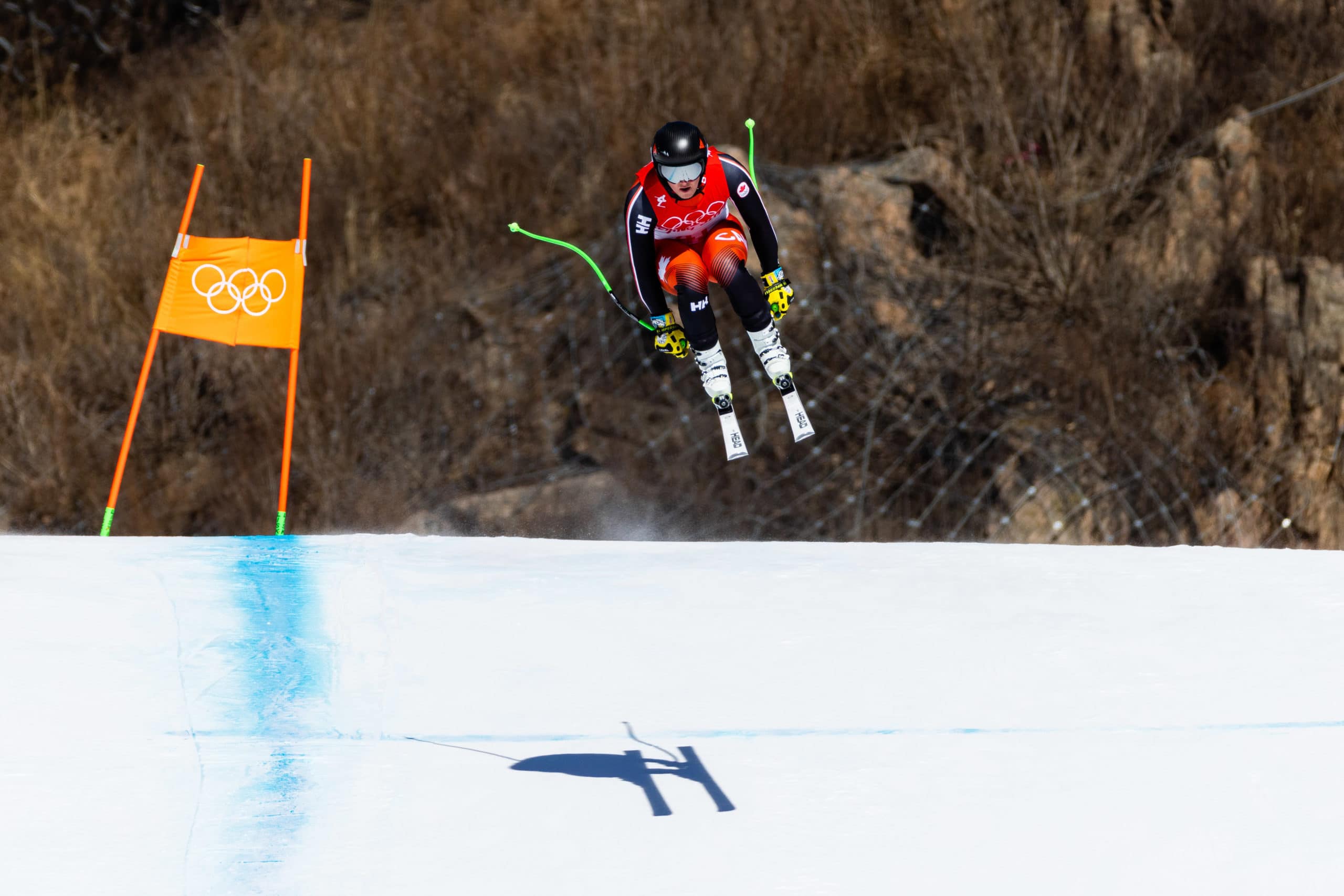
FIS race director Markus Waldner described the venue as “challenging and demanding,” and said strong winds expected in the area will play a factor up until Sunday’s downhill race (which is scheduled to take place Saturday night North American time).
Two-time Olympic champion Matthias Mayer, of Austria, also believes the course won’t be an easy one to negotiate. “The snow reminds me of North America,” he said. “The terrain looks good, relatively steep, it should be challenging.”
Thursday’s training run gave the world its first glimpse of ski racing on this track – and the first downhill in China. So it’s a real wonder who will emerge this week with Olympic hardware. Dark horses? No clue.
National-teams coaching staff and administrators from all nations will, no-doubt, have done their due diligence to scope out the terrain – video footage, terrain maps, etc., but Thursday’s first training run will be the first real carved turns down this mountain. Normally, test events give skiers a chance to experience the “exotic” tracks not normally a part of the World Cup circuit, but the Covid-19 pandemic put a stop to all of those plans.
Like any other ski race, at all levels, Mother Nature could take control and influence the outcome. But at the end of the day(s), there will be 33 medals awarded for alpine events at Beijing. Can the Canadian men’s team snag one?
Canadian contenders
Jack Crawford
Likely the best chance at men’s Olympic hardware comes from the 24-year-old from Toronto. He’s an emerging big-event ski racer. With only four-career top-10 World Cup finishes, you might wonder if it’s too early to consider him an Olympic medal threat. Last month, Crawford posted fifth- and sixth-placed finishes in Wengen, Switzerland, and Kitzbühel, Austria, on back-to-back weekends. Then, he won a Europa Cup downhill in Saalbach, Austria, just before flying to China. Crawford also posted the fastest time in the super G portion of the men’s combined at the 2021 Worlds in Cortina, Italy (ultimately finishing fourth) and he has a whopping six top-10 finishes at the world juniors. Those are big events. This could be Crawford’s time to grab the world’s attention.
Erik Read
The Calgary, Alberta racer is a true workhorse. With nine top-30 finishes on the World Cup this season alone – a whopping 55 in his career to go along with 11 NorAm wins – the 30-year old has consistency, stability and experience. With a silver medal at the 2015 World Championships team event, along with an 11th place finish in the GS in his Olympic debut at PyeongChang 2018, Read has “weathered the storm” of pressure and expectations and could be a dark horse in the men’s giant slalom.
Brodie Seger
It’s been a weird season so far for the 24-year old North Vancouver racer. His best World Cup finish is a 17th at the Wengen super-G and his best downhill is 31st at both Lake Louise, Alberta, and Bormio, Italy. Leading into the season, the older Seger – his younger brother Riley is on the men’s combined team and has two NCAA wins in January – was expected to lead the team after his fourth-place finish in the super-G at the world championships in Cortina. Now he aims to translate that performance into Olympic success.
Trevor Philp
Along with Erik Read, Philp gives Canada a second threat to podium in the men’s giant slalom. Also an Alberta-bred racer, Philp is a four-time All American from the University of Denver – and has steadily plotted away at becoming a stronger, more adaptable racer. Collecting 15th- and 19th-place finishes in Alta Badia, Italy, in late December – including the fastest second run time on Dec. 20th – has this Canadian on the medal map.
Broderick Thompson
Consistency has not been on his side so far this season, but Thompson has the speed and form to make a splash in Beijing. Thompson, brother of Marielle, who is competing in the women’s ski cross, has tasted World Cup success in Beaver Creek with a third-place finish, and could benefit from the new track this week with his balance of power and athleticism. “Everyone is hungry and the team is in a good place to push,” said Thompson.
Mixed Team Parallel Event
This is Canada’s best shot at Olympic hardware. The Canadian mixed team could be more in the driver’s seat in this event which will be the last alpine event of the Olympics (Feb. 19th). With a group of experienced parallel racers and confidence from previous successes in team events, the Canadians will be in the running.
The Associated Press contributed to this report.
About the Author: Gordie Bowles