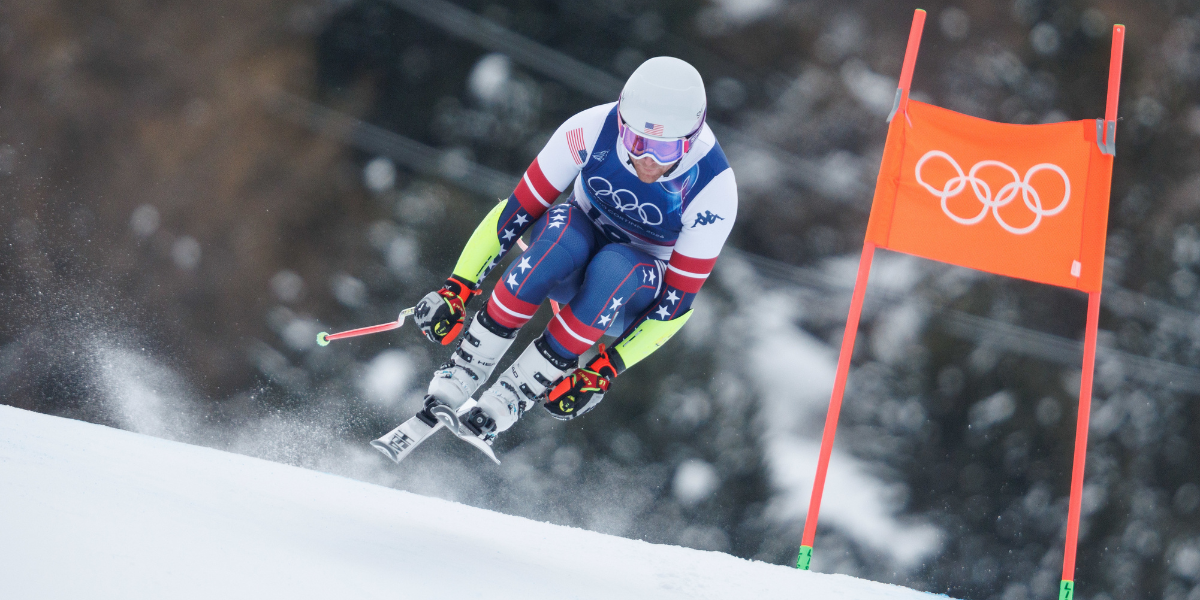
Ryan Cochran-Siegle / Bormio Stelvio Olympic training / GEPA pictures
BORMIO, Italy — The Stelvio downhill has long ranked among the most feared tracks in alpine skiing, not just for its speed but for how little security it gives the athletes who race it. When the World Cup arrives in late December, flat light cloaks nearly the entire course. The terrain becomes difficult to read and physically exhausting. Skiers can’t see the bumps coming, so they never fully relax, bracing for the next unknown impact from start to finish.
This week, rare February sunshine at the Olympics changed that experience entirely.
A Rare View From the Start Gate
Bryce Bennett, who has raced the Stelvio on the World Cup since December 2018, noticed the difference immediately.
“For once, you stand in the start gate and just see sun,” Bennett said. “It’s a good feeling, a rare feeling. I’ve never had that in my career here.”
Bennett, Ryan Cochran-Siegle and Sam Morse are all seeing Stelvio in conditions that feel unfamiliar. The track last hosted racing this late in the season at the 2005 World Championships, when Americans Bode Miller and Daron Rahlves finished first and second. That result turned the U.S. team house into a legendary celebration that night.
Intensity Still Defines Stelvio
Sunlight hasn’t softened the course’s character.
“It’s still very intense — high speed, big turns, a lot of bumps,” Bennett said. “But today’s training was really good. We’ll just see how the weather plays in our favor the next couple days.”
The second training run gave racers a clearer sense of how aggressively they could attack key sections.
San Pietro Jump Comes Alive
One of the biggest changes between the first and second training runs came at the San Pietro jump, a distinct feature of the infamously dangerous piste. Bormio’s tourism site boasts of a “spectacular leap of over 40 meters.” On the second training day, racers finally approached it with commitment.
“It was way better,” Bennett said. “That’s a jump you can take really far. Yesterday it was super disappointing, so it’s always nice to have a big jump.”
Cochran-Siegle Finds Trust in the Light
Ryan Cochran-Siegle said the improved visibility helped him trust both his skis and the surface.
“With the full sunshine, you could see the majority of the course much clearer,” Cochran-Siegle said. “The skis were smoother through the turn. It was fun to ski, and there’s still stuff to learn from.”
He said the second training run offered a better preview of race-day intensity.
“Today is probably more indicative of what the top guys will be pushing for,” Cochran-Siegle said.
Morse Embraces the Chaos
For Sam Morse, the day stood out less for speed and more for experience. On a course that usually demands survival, there was room to enjoy the moment.
“Today was an all-time day of enjoyment,” Morse said. “Not the fastest times, but skiing Bormio in the sun was really special.”
Course crews reshaped sections overnight, adding another layer of challenge.
“Some sections got better, others got worse,” Morse said. “That’s what makes it exciting. If it’s perfectly smooth, nobody makes mistakes. This will be about who recovers best.”
On race day, clouds may return and visibility may fade. The adrenaline will not. For one day, Stelvio showed a different side and introduced the U.S. men to what is possible on one of skiing’s most demanding Olympic stages.
About the Author: Peter Lange