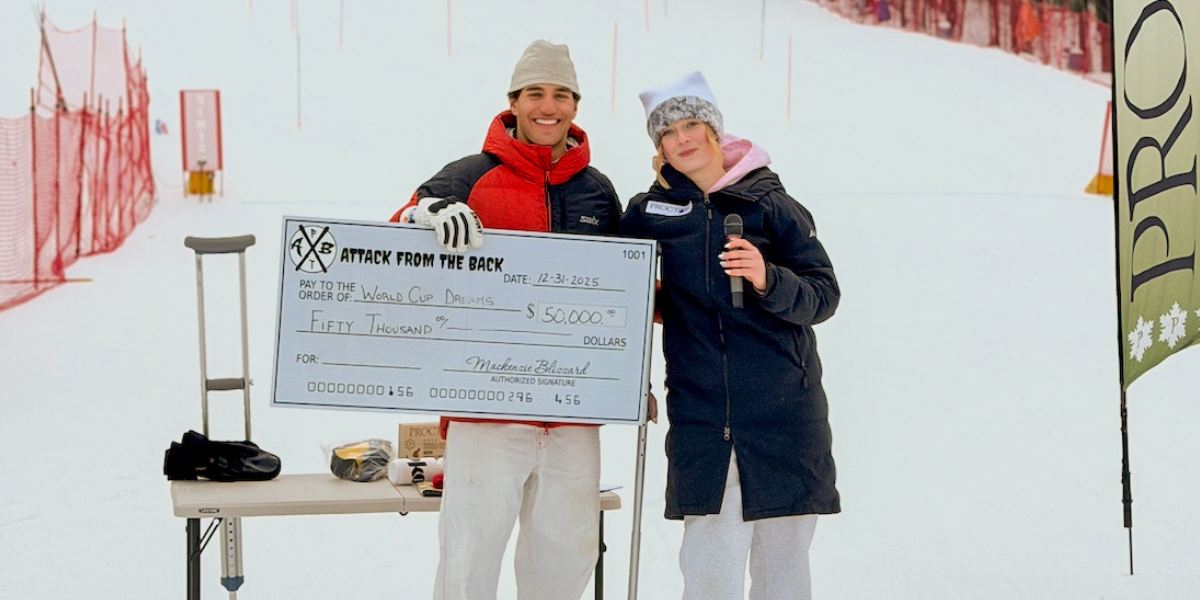
Mackenzie Blizzard delivers $50,000 donation to World Cup Dreams at Proctor Academy
At 16 years old, Mackenzie Blizzard has already lived a life shaped by resilience, purpose and an uncommon drive to help others. She is an alpine ski racer, a student and the founder of Attack from the Back, a ski shop and online business that donates all profits to charities supporting youth education and access to sport.
Her story, however, is rooted in a childhood medical diagnosis that forced her to redefine what competition, success and possibility would look like.
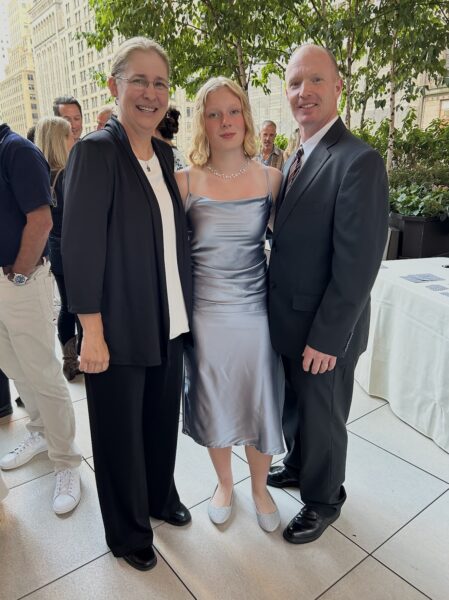
In 2025, Blizzard surpassed her annual fundraising goal, donating $110,000 to organizations including World Cup Dreams and Education Rocks. The milestone was marked on New Year’s Eve at her home hill, Proctor Academy, where she was later honored alongside her parents, Jack and Renee Blizzard, for her growing impact within the ski community.
Her achievements are remarkable not only because of her age, but because of the path that brought her there.
A Childhood Interrupted
Before skiing became central to her life, Blizzard was already excelling in another sport. By age six, she was a standout competitive swimmer, winning eight of 10 events at the Middle Atlantic Championships at La Salle University. Her success earned her the opportunity to train with Michael Phelps’ coach in Baltimore, and she spoke openly about her Olympic ambitions.
Then, without warning, everything changed.
At the conclusion of a swim meet, Blizzard suffered what appeared to be a stroke in the pool. She was rushed to the emergency room, beginning months of neurological testing, hospital visits and unanswered questions. Eventually, doctors delivered a diagnosis that would reshape her life: 11 inoperable brain tumors and mitochondrial disease.
For a young child, the news was overwhelming. Blizzard endured frequent strokes, episodes of paralysis, chronic pain and extended hospital stays. Still, her focus remained strikingly simple.
“She just wanted to know when she could get back to the pool,” her family recalls.
Adapting to a New Normal
As the reality of her condition set in, Blizzard learned to adapt. A service dog named Simba was trained to alert her to oncoming strokes, allowing her to remain engaged in school and daily life. Rather than being defined by illness, she found ways to stay connected and active through photography, crafts and whatever physical movement her doctors permitted.
On difficult days, she rested. On better days, she did everything she could.
Over time, medication helped reduce the frequency of her strokes. By age 10, doctors cautiously approved limited physical activity. Competitive swimming was no longer possible, but Blizzard embraced new opportunities with enthusiasm, celebrating what she could do rather than focusing on what she had lost.
A New Beginning on Snow
Skiing had always been part of Blizzard’s life, but only briefly — a single weekend each winter. That changed during the COVID-19 pandemic, when remote learning allowed her family to spend an entire season at Mount Snow in Vermont.
For the first time, skiing became a routine.
Blizzard enrolled in lessons three days a week and completed her schoolwork in the evenings. Under the guidance of former World Cup alpine racer Sally White, her progress accelerated quickly. White noticed Blizzard’s natural feel for the sport and began introducing racing fundamentals into her instruction.
Despite understandable hesitation from her parents, Blizzard continued to ask for a chance to compete.
“Mom, I think I’m really good, and you should at least let me try,” she said.
After consulting her neurologist — who supported the idea — her parents agreed.
Learning to Compete Again
With White’s encouragement, Blizzard traveled to Burke Mountain Academy to meet Olympic gold medalist and junior program director Diann Roffe. With just weeks remaining in the season, Blizzard joined the Mount Snow Academy for two races.
She finished 10th in her first giant slalom at Stratton Mountain.
The result was enough to build her confidence.
Blizzard applied to Burke Mountain Academy’s U14 program and was accepted. Her first season was marked by long days and steep learning curves, but steady improvement followed. By season’s end, her hard work earned her a silver medal at the Eastern Finals.
Now a freshman at Proctor Academy, Blizzard is preparing for her U16 alpine season. Physical challenges remain constant — chronic pain, headaches and slow muscle recovery — but her determination has never wavered.
“To be competitive, she has to work harder than everyone else,” those close to her say. “And she does.”
Turning Purpose Into Action
Blizzard’s experiences ultimately led to the creation of Attack from the Back, a name inspired by ski racing itself — the idea that athletes starting deep in the field can still charge through ruts and adversity to deliver standout performances.
“My favorite part of Attack from the Back is that it’s bigger than just selling ski gear,” Blizzard said. “It’s about building a community around grit, passion and showing up even when things are hard.”
The shop is based in New London, New Hampshire, and has an online presence that supports its broader mission. Every dollar of profit is donated to organizations that help young people access education and snow sports — opportunities Blizzard believes should never be taken for granted.
“My health challenges changed how I view life,” she said. “They taught me not to take time, opportunity or my body for granted. Building this business became a way to turn struggle into strength.”
Recognition and Momentum
Ian Harvey, U.S. brand manager for Toko at Brav USA, learned of Blizzard’s story last year and has since become a strong advocate for her and her mission.
“When you realize how inspirational it is when a skier with a high start number attacks the course despite all the ruts and still does really well?” Harvey said. “That’s exactly what Mackenzie represents.”
“I can only say that I am grateful that rock stars like Mackenzie Blizzard exist for us normal folk to see what living to one’s potential really looks like,” he added.
At just 16, Blizzard continues to redefine what genuine impact in the ski community can look like — not through results alone, but through generosity, perspective and purpose.
Sometimes the most powerful runs don’t start at the front.
They start from the back.

About the Author: Peter Lange