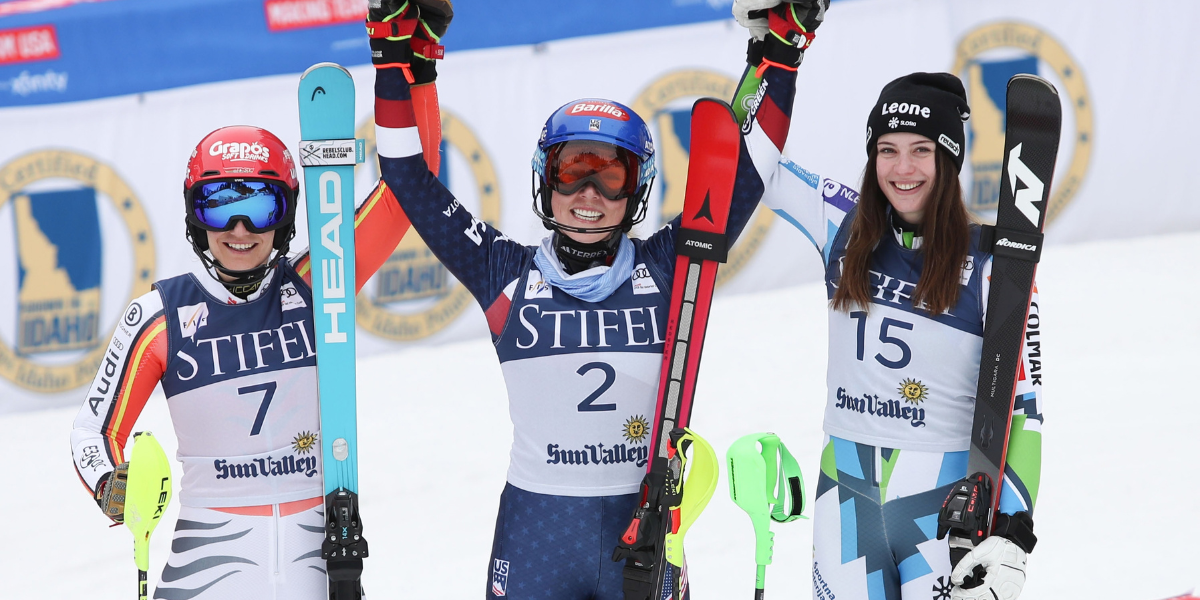

Featured Image: Katharina Truppe. Provided by GEPA
With screaming speed, we’ve watched Alexander Kilde resist G-forces that would squash a lesser individual. His massive legs, the result of years spent under the squat bar, keep his skis on track. If his bulging speed suit was green, he could easily be mistaken for the Incredible Hulk. So, one must ask: “Is it just about strength?” “Does strength win ski races?” Well, yes and no! Yes, because ski racers need to be strong, but no, because ski racers also need endurance.
A conundrum
The challenge is to incorporate and balance strength and endurance. These two physiological processes stem from differing forms of energy metabolism, which require different training approaches and can counteract each other.
Strength
Resisting the intense external forces of a ski turn takes tremendous strength. Keeping the skis fixed to the snow requires power. Strength combined with power can be thought of as the “fast-twitch” or anaerobic component of training. Anaerobic (without oxygen) means the body converts energy without needing oxygen.
Endurance
The winning time in men’s downhill last season ranged from 1:40.04 to 2:22.58 (Beaver Creek & Wengen) with an average of just under two minutes (1:56.33). For an event this long, oxygen is essential. This is aerobic metabolism, meaning the body produces energy utilizing oxygen.
Back to the conundrum
In weightlifting, competitors lift a heavy weight once, which doesn’t require oxygen. If the lifter raises the bar additional times, the weight decreases, and eventually they’ll need to breathe to maintain the demand. The most exciting events to watch in track and field are the races ranging from the 400-meter hurdles to the 1,500 meters. Due to the demand for speed and the ability to maintain that speed (endurance), you never know who will win until the final 100 meters of the race. The runner who gained the massive lead has exhausted their legs and has nothing left for the sprint. This is what happens at the Lauberhorn downhill in Wengen. Watch the final two turns, set more like a GS, and see the best ski racers in the world skiing as if their legs were made of wood. They have the strength but not the endurance to fuel the muscles and use that strength.
Volume is important
To race and train, you need reps, which in training theory language is called “volume.” From Aján to Zatsiorsky, every training book inevitably starts with a chapter about the importance of volume. Without volume, athletes limit their practice. Time that should be spent on the extra run or the extra set ends up with the skier on the couch, channel surfing. According to motor control expert Richard Schmidt, “Practice is the most important component in mastering a motor skill.” You must have volume to practice.

Open-skilled sport
Alpine ski racers compete in a dynamic, unpredictable, and externally paced environment. The ski racer must constantly adapt to the changing conditions. Developing skills for ski racing is not like increasing your bowling average. Bowling motions do not vary much. While you can’t discount volume for the closed bowling skills, the volume needed in the open-skilled sport of ski racing is exponentially increased. The more variables, the greater the required volume.
Conjugate sequence training
Earlier, we noted that the two energy systems can conflict. You have never seen a muscle-bound marathoner or a skinny weightlifter. Ski racers need to be a combination of both. Training that alternates between emphasis blocks (2–3 weeks) can build strength or endurance without compromising previous gains.
Anaerobic glycolysis
There is an intermediate energy system. Athletes can train this system after they build strength and endurance. That hot, heavy feeling in the legs and the extreme need to breathe after a full-length, intense race run is the body’s need for more strength and oxygen. This is when the anaerobic and aerobic energy systems work together. This in-between system, when trained (think tightly spaced intervals), teaches the body to utilize the accumulated lactate to produce additional energy. Anaerobic glycolysis means breaking down glucose without oxygen, which produces lactate. Though not highly efficient, it still provides short-term fuel. More importantly, it allows an athlete to stay in fifth gear through the finish line. Athletes must build this training on a foundation of strength and endurance.
Bottom line
While looking like the Incredible Hulk in your speed suit is impressive, so is standing on the podium. Winning a medal requires more than looking strong—it takes fast skiing. That means having the endurance to put in many training runs and the stamina to go full gas from start house to finish line.
Final conundrum
The demands of ski racing require high strength for the individual turn and the endurance to get to the finish line. The challenge is balancing the two opposing energy systems.
About the Author: Ron Kipp